



For many people, the US operation in Venezuela appeared to have come out of nowhere. The move to capture President Nicolás Maduro and fly him to New York to face federal charges triggered international outrage, legal debates, and geopolitical alarm over US intentions in the Western Hemisphere.
But to those familiar with Technocracy, the logic of the US “managing” Venezuela has been visible, if rarely spoken about publicly, for nearly a century.
The Technocratic strategy, put simply, is that the Western Hemisphere must function as a single, integrated system — governed by logistics, energy flows, security, and administrative compatibility.
In the 1930s and 1940s, technocratic planners openly published maps of what they called the Technate of America: a continental zone encompassing the United States, Canada, Mexico, Greenland, Central America, the Caribbean, and the northern tier of South America. Their justification was blunt: political borders were abstractions. What mattered were rivers, ports, energy basins, shipping lanes, population centers, and defense perimeters.

A continent, they contended, cannot be defended, fed, or stabilized piece by piece. A September 1937 edition of ‘The Technocrat’ magazine put it plainly:
The Technate will encompass the entire American Continent from Panama to the North Pole because the natural resources and the natural boundaries of this area make it an independent, self-sustaining geographical unit. Technocracy’s blueprints have been designed for this continent and for no other. It is an American Plan for the American continent. No imported political philosophies, including Democracy, are in any way applicable.
What we are witnessing now is not the resurrection of an old idea, but its delayed implementation.
Look at the Technate map and you’ll see large portions of it that are no longer theoretical. They are functionally integrated, even if no one cares to admit it publicly. Although the so-called leaders of each country appear to have differing views and don’t always get along, the United States, Canada, and Mexico now basically operate in unison, like administrative zones within a single, shared platform.
While the democracy they enjoy is largely performative, energy grids, supply chains, and security coordination are interoperable. Trade disputes are resolved inside shared frameworks, not at arm’s length or by gunboat. Sovereignty sounds nice, but it’s a ruse. From a systems perspective, North America already behaves as a single continental unit wearing three political skins.
In fact, that is precisely why Mexico sits in such an uncomfortable position currently. It is too integrated to be treated as foreign, yet too unstable to be left fully autonomous. When Trump says things like, “we’re going to have to do something,” about Mexico the language sounds shocking, but the underlying reality has been trending that way for decades.
Central America and the Caribbean form what technocratic planners would call a ‘managed buffer zone.’ These regions absorb economic shocks, humanitarian crises, migration surges, and security spillovers that would otherwise reach the continental core. They are saturated with NGOs, aid frameworks, disaster-response regimes, security training programs, and financial dependency. Sovereignty remains on paper, but real decision-making is constrained by dependency. Control is exercised through permanent crisis management.
And then there’s Greenland. Last weekend, President Trump reiterated his desire to take over control, for the sake of national security. He described the region as “covered with Russian and Chinese ships all over the place.”
Greenland appears again and again in the original Technate maps, because it controls the northern approaches to North America: Arctic sea lanes, North Atlantic air corridors, early-warning radar geometry, missile defense sightlines, and undersea cable routes. As ice melts, its strategic value only increases.
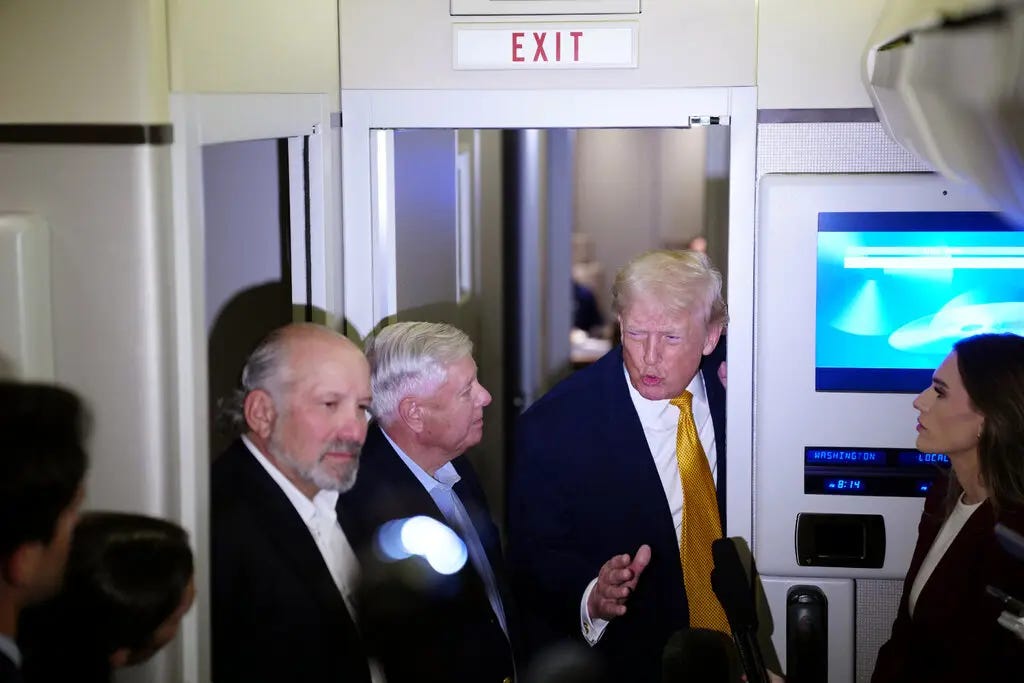
Donald Trump publicly floated the idea of buying Greenland during his first presidency in August 2019, when he told reporters that the United States was considering purchasing the Danish territory for strategic reasons. At the time, that idea was met with widespread rejection by Denmark and Greenland and described as “absurd.”
It’s worth noting that even though Greenland formally belongs to Denmark, functionally it is already integrated into North American defense infrastructure. Having a US base there is normalized. NATO frameworks handle security; local autonomy does not extend to strategic decisions. This is soft-border integration in its purest form: no annexation, no public debate, no spectacle. Just control.
Thus, by the early 21st century, most of the Technate map was effectively in place — except for one critical band: the northern swath of South America.
Colombia has long been deeply embedded in US security and counter-narcotics architecture. Intelligence cooperation, training, and logistics are extensive. In system terms, Colombia is already well inside the Technate. What has changed, however, is leadership alignment. When a node inside a tightly coupled system becomes politically unpredictable, it is treated as a maintenance problem. Thus, Trump’s rhetoric about Colombia being “run by a sick man” is crude but reflects a systems judgment about reliability, not morality.
Guyana and Suriname matter because of their resources: oil, minerals, and offshore energy. Their integration is happening quietly, through investment and infrastructure rather than confrontation. Because they are not resisting, they are quietly being absorbed.
That’s what made Venezuela different. It is a resource-sovereign, energy-rich, demographically significant, and politically non-compliant country. It has resisted IMF-style leverage, NGO saturation, and administrative harmonization, all while cozying up to the BRICS alliance.
It was also an obvious beachhead for foreign adversaries.
From a technocratic perspective, Venezuela was not merely a hostile government. It was an uncontrolled node — a vulnerability in continental defense, energy coordination, and migration management. This is why the country was framed, year after year, as a humanitarian crisis, a narcotics hub, and a governance failure. Those descriptions translate a systems problem into a moral justification.
Seen in this context, the raid on Venezuela makes more sense and starts to look more like closure. Trump’s language about “running the country until a safe transition” is the language of systems maintenance, not empire-building.
Cuba, notably, is treated differently. Trump says it will “fall on its own.” That reflects a calculation that Cuba no longer functions as a meaningful node. It is already hollowed out, exhausted, and collapsing inward. The Technocrats are betting that it does not require intervention, only patience.
(If you’re wondering exactly who “The Technocrats” are and how they have so much influence, check out the following podcasts.)


For decades, technocratic integration has been advancing quietly: through trade agreements, aid regimes, security partnerships, and crisis narratives. Trump has a habit of saying the quiet part out loud and in doing so, he has revealed the underlying logic that polite language has been concealing. The raid on Venezuela simply marks the point where soft borders harden, gaps close, and the patience for non-compliant nodes disappears.
If you’re one of those people feeling shock at what’s happening right now, it’s only because you were taught the world map was real and the map of the Technate was a conspiracy theory.
It wasn’t. It was a working draft, and now most of it is already built.
As the Technate begins to coagulate, you should know that the technocrats — the “experts” who will run this massive experiment — are queued up and waiting in the wings. In the ensuing years between Technocracy’s founding (1932) and where we find ourselves today, an entire class of psychopathic tech oligarchs emerged from Silicon Valley, the devil-spawn of the very thing (the internet) that was supposed to set humanity free through liberated information and instant communication.
Instead, the technology these oligarchs control, as well as its backbone, give them access to and jurisdiction over each and every intimate data point about our lives, diligently collected over the past 20 years and now subject to algorithmic analysis in a split second by AI. These oligarchs are the puppet masters; they are the plantation owners. Soon, that control — whether over food, energy, transportation or any other consumptive behavior — will be the prison from which there is no escape.
Join Zahra Sethna and Courtenay Turner on the Collapse Life podcast this Saturday, January 10, for a fuller discussion about where things stand in the march towards technocracy.

The ending doesn't look good:
"Soon, that control — whether over food, energy, transportation or any other consumptive behavior — will be the prison from which there is no escape."
It just doesn't sit right with my visions of possible futures. I know it's gonna be bad but I never envisioned it to be inescapable.
I could just be a naïve dreamer failing to see reality but there's so much we don't know and have yet to discover about life and humanity. We don't know everything and aren't all powerful, but by observing Nature we can see where we came from and how the web of life is interconnected. That is what we can't escape, not the digital technocratic prison envisioned by psychopaths.
In Nature there are exceptions to the rule as life constantly adapts to new situations. It's designed to regenerate and rebound and perpetuate as a mega system. Humanity is still trying to control it, be above it, be God.
It's not happening. Our destiny lies in harmony with Nature not control over it. History has shown us our limitations when it comes to superseding our place in the complex web of life. We are what we are, including all the trillions of microscopic viruses, exosomes, enzymes, genetic codes, molecules and atoms. We are a miracle and part of a "plan" I think, that is so big and complex we can barely fathom it.
So maybe we will have to suffer when they try to control everything but I know they will never escape what they really are, so we will have to adapt, like a microbe mutating, to live again.
probably one part of the epstein jimmy savile diddy club