


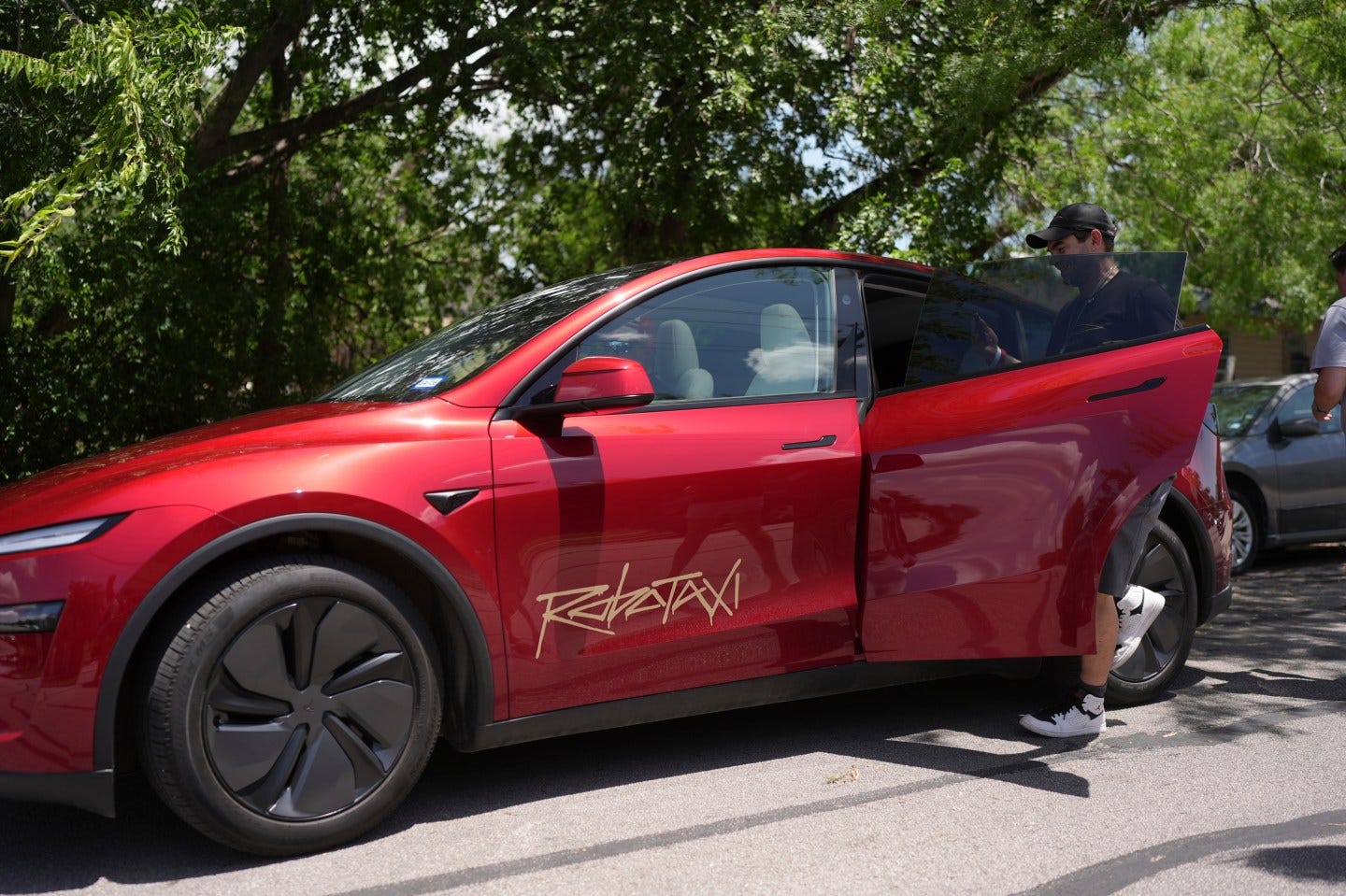
Last week, we brought you Waymos swarming an Atlanta suburb like a futuristic merry-go-round. This week, we see Elon Musk — the man who promises Mars colonies are just around the corner — confronting reality: the driverless future still struggles with fences, chains, construction barricades, and basic spatial awareness.
Newly unredacted crash reports submitted to the National Highway Traffic Safety Administration reveal that Tesla Robotaxis have crashed at least twice while being remotely piloted by human teleoperators, with a human safety monitor sitting in the front seat. In one case, the remote operator drove the vehicle into a fence. In another, it scraped a construction barricade at 9 mph. Which raises an uncomfortable question: if even the backup human can’t reliably operate the thing at golf-cart speeds, what exactly is the revolutionary breakthrough we’re being sold here?
The incidents are small enough to sound almost comical. Tesla robotaxis clipped mirrors, tangled with parking lot chains, and failed to avoid a dog darting into the street. The dog escaped unharmed, but sadly our faith in ‘frictionless’ AI perfection did not.
To be fair, every autonomous vehicle company has incidents. Tesla is hardly alone. But the mythology around AI increasingly depends on the belief that human beings are the weak link and that software can smoothly manage the chaos of the real world. Yet reality keeps intervening. Who knew that things like uneven streets, confusing construction zones, random dogs, or bad weather would provide humanity’s defense against the singularity?
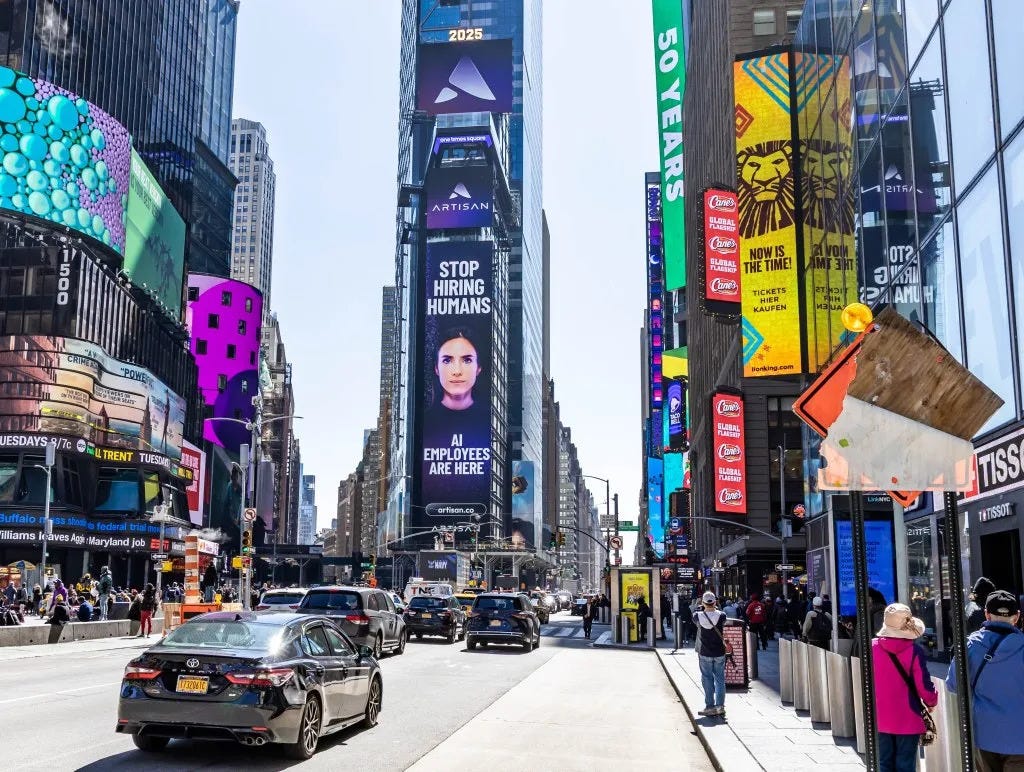
“Stop Hiring Humans” is the kind of deliberately provocative marketing messaging that sounds edgy and solicits enthusiastic nods in a Silicon Valley pitch deck.
But when billboards started showing up on the streets of New York and San Francisco, and more recently in the skies over the Bay Area, it landed a bit differently than in the tech bro echo chamber, particularly at a time when millions of people are already anxious about layoffs, stagnant wages, and automation creeping into knowledge work.
The human backlash to AI has been on full display this commencement season, with graduates repeatedly booing speakers who praise AI. At a ceremony at an Arizona community college last week, the wrong names were read and in some cases the graduates' names were not read at all. "We're using a new AI system as our reader," the college president said, leading to loud boos from the audience. (That’s some clever use of AI there, institution of higher learning!)
Graduates in Tennessee were told by their commencement speaker that, “the things you learned in your first year here may already be obsolete.” In his speech at Middle Tennessee State University, record executive Scott Borchetta said the quiet part out loud, telling graduates, “AI is rewriting production, as we sit here.” When they booed him, he said: “Hey, then do something about it. It’s a tool. Make it work for you. You can hear me now, or you can pay me later.”
That particular part of Borchetta’s speech at once condemns higher learning as the useless institution it has become, as well as illustrates that the “great bifurcation” — as yesterday’s podcast guest, Mark Jeftovic, calls it — is underway at full speed. Pretty much everyone is going to be steamrolled because of how fast it’s all moving and how long it will take most people to adapt… cognitively and otherwise.
At the University of Arizona on May 15, when former Google CEO Eric Schmidt told graduates not to fear AI and instead to reclaim their agency and figure out how to help shape it, he was repeatedly met with jeers and boos from the audience.
The same thing happened to real estate executive Gloria Caulfield during her remarks to graduates at the University of Central Florida on May 8. She was caught off guard by the reaction when she said, “The rise of artificial intelligence is the next industrial revolution.”
The reaction is significant, because college graduates are normally the demographic most culturally aligned with technological progress. They are supposed to be the optimistic adopters already inhabiting the future. If even they are beginning to recoil, it suggests something deeper is shifting psychologically.
The older generation of commencement speakers, comfortable in their own success, largely view AI as a tool for increased efficiency and creative breakthroughs. To them, replacing a dozen workers with one AI-assisted operator is a gain. But to the students saddled with debt and hoping to break into their first employment, it evidently sounds like the people holding the reins have no intention of bringing them along.

Just when when you thought that great national nightmare was finally memory-holed, Texas steps up with a reminder. It’s true that everything is bigger in Texas, including the delusion.
Mary Talley Bowden MD to the rescue.
She says some institutions are defying Texas state law and still mandating COVID vaccinations. This includes some medical schools and training institutes. Dr. Bowden recently posted this, for anyone who may need the support:

And if you’re in Utah, there’s this:

A shout-out to both doctors for their courage and bravery in supporting individual choice and bodily autonomy.
Now gird your loins for Ebola and/or Hantavirus. Incoming in 3… 2… 1…
The scamdemic is far from over.. it's just under contract with a new marketing manager.
The reality of AI is moving into orbit (literally)...
https://www.scribd.com/document/990167804/SpaceX-Orbital-Data-Center-Request
Don't let the hype and supposed altruistic motives fool you... this has very little if nothing at all to do with "significantly reducing the environmental impact associated with terrestrial data centers"... that's the come-on! It has everything to do with an effort to safeguard the infrastructure by placing it in an untouchable domain... space... away from the threat of anticipated sabotage by an unruly population who will finally realize that it's their prison wall.