


Before we get to this week’s collection of stories, we have a bit of good news directly related to you and your support of what we do.
Collapse Life is now officially a Substack bestseller, almost three years to the day from when we launched.

We share this news with enormous gratitude and humility.
Thanks to all of you who read, comment, share, and support our work — with special shoutout to friends like Peter Grandich and Michael Gentile, who have actively given their time, without compensation, for things like interviews and subscriber-only metals and mining debriefs. No words can express our thanks to them, and to you all.
Of course, “bestseller” alludes to paid subscribers, and we are especially grateful to all who have subscribed at that level. Your support makes this endeavor possible and motivates us to keep researching, writing, interviewing, and providing the necessary snark needed to get through another week out here on the edge.
We’re so grateful to have you all with us on this journey.
This past Wednesday, Collapse Life had a wonderful livestream with Abraham Ojeda about strategic relocation, uncertain times, and the difficult question of whether staying put is more of a risk than moving on. If you missed it, you can rewatch the conversation below.
We recently asked whether the border wall might someday be used to keep Americans in, rather than migrants out. And now, as Leo Hohmann points out, the idea just got a bit more dystopian.
A company called Foundation Future Industries is pitching its Phantom humanoid robots to DHS for border patrol and says it is negotiating with multiple national security agencies.
“We’re in conversations with almost all national security government bodies, so Air Force, Navy, Army, DHS,” the company’s CEO, Sankaet Pathak, told Fox News. “We continue to have dialogues. We’re starting to negotiate contracts and some applications for them.”

The machines are already being developed for reconnaissance, breaching operations and, eventually, carrying the same weapons as human soldiers. Foundation has secured a combined $24 million in military research contracts — and its investor and chief strategy adviser is Eric Trump. TIME reports that the company is in close contact with DHS about border patrol applications; Reuters confirms Eric Trump’s financial stake.
So the administration builds the surveillance border, the president’s son invests in the company hoping to supply its robot guards, and taxpayers potentially fund the whole thing. Nothing says “secure border” quite like a heavily armed family business with facial recognition.
Five people were recently hospitalized during an outbreak of typhus in Los Angeles’ Pico-Union neighborhood. Everyone recovered, but county officials say cases are continuing to rise and 2026 is on track to break last year’s record.

The disease — spread by fleas carried by rats, opossums, and other animals — has risen from just nine reported cases in 2009 to 220 cases in 2025, as garbage, crumbling infrastructure, homeless encampments, and inadequate rodent control turn parts of America’s second-largest city into a medieval medical theme park nobody wanted.
County officials reportedly admit that the growing caseload is already exceeding their ability to investigate and respond. But residents are advised to secure their trash, treat their pets for fleas, and avoid stray animals. In other words, Los Angeles has successfully decentralized public health.
Welcome back, typhus. We’d say we missed you, but absolutely no one did.

A recent essay in The New Yorker helped us understand the growing popularity of socialism among urban professionals: basically, these folks are discovering that capitalism no longer guarantees them and their children elite lives, and in doing so they’re realizing the current economic order is morally unacceptable.
The deepest irony in writer Jay Caspian Kang’s account of becoming a “Subaru Socialist” is that he doesn’t appear to want the class structure abolished. He just wants to make sure his daughter won’t fall out of the social status he successfully secured. His pursuit of socialism is, therefore, less proletarian revolution than upper-middle-class status insurance: preserve the Subaru, the prestigious career, and the expensive education, but socialize more of the risk required to obtain them.
When I had children, though, I found myself moving further toward broad, fuzzy support for anything semi-socialist. My wife and I could afford child care, but we could also see just how little would have to change to make that impossible. And during the first Trump Presidency it became quite obvious to me that, although I had somehow become more successful as a writer than I ever could have imagined during my days of unemployment and rejection, the job was shakier and less stable than it would have been not that long before.
Kang is unusually candid about this, explicitly calling his politics self-interested. And he’s not wrong that housing, health care, and professional stability have deteriorated. But recognizing capitalism’s failures only when they threaten your own life and family’s future is not exactly class consciousness. It is class anxiety with a Bernie Sanders bumper sticker.
This week on the Signal Map, we’re tracking the first criminal crack in the COVID accountability wall, a troubling cluster of church fires, the widening gap between what’s happening in Hormuz and what we’re being told is happening in Hormuz, Europe’s nervous reassurances about cash, and the apparently radical discovery that phones can be switched off to achieve a degree of peace.
(For those with bad eyes — like us! — be sure to click on the image to make it larger)
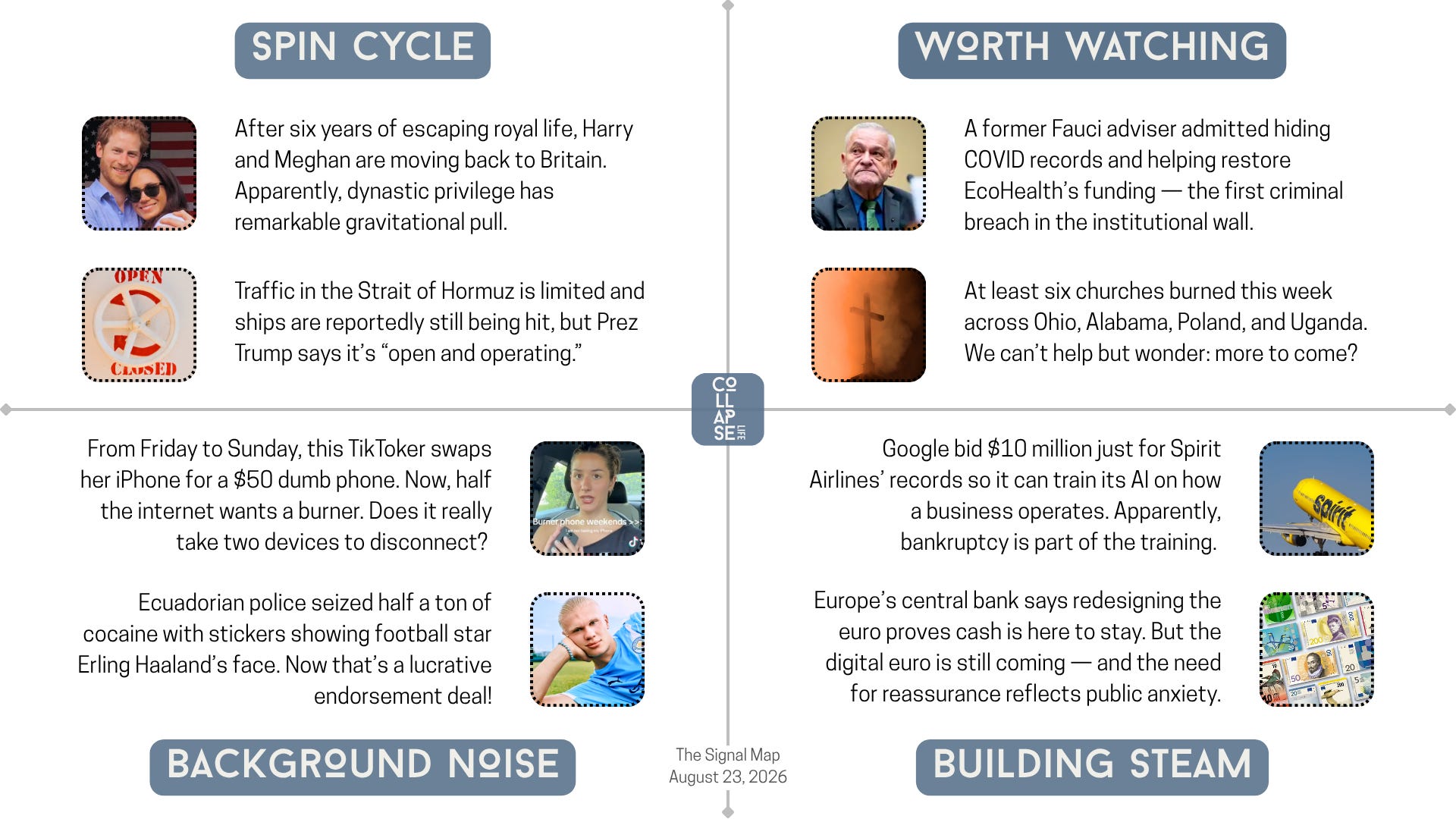
Read the stories behind this week’s map:
Former Fauci adviser admits hiding COVID records → Reuters
Google bids for Spirit Airlines’ data → Simple Flying
Europe’s central bank redesigns euro banknotes → Euronews
Burner-phone weekends go viral → TikTok
Footballer’s face appears on cocaine packages → Yahoo News
Harry and Meghan reportedly return to Britain → The Sun
Trump says Strait of Hormuz is “open and operating” → Associated Press