

Notes from the edge of civilization: January 25, 2026
Ivory towers collapsing; China buys another American icon; kill switches are coming to your car; and, Larry Fink literally tells you what's next.

Higher education is facing a long-overdue reckoning. In a talk earlier this month, Arthur Levine,* president of Brandeis University, contended that 20–25% of American colleges are likely to close in coming years.
He says this is because universities are still running an Industrial Revolution assembly line in a digital economy. Enrollment is falling, costs are absurd, outcomes are opaque, and a university degree is no longer a reliable signal of competence.
Institutions with deep endowments may be able to delay the reckoning; others may continue the growing trend of admitting international students who pay full tuition, not for the learning, but for proximity to the US labor market and immigration pathways. This keeps campuses solvent in the short term, but it decouples tuition from academic rigor.
As a consequence, this compounds the crisis at the very moment when faculty are confronting a student body that increasingly cannot do the most fundamental prerequisite of higher education: sustained reading. As we noted this week, professors report having to read texts aloud in class because students cannot process written language independently. The problem is that stamina, attention, and training have all quietly eroded.
Levine has grand plans for remaking the very nature of the curriculum at Brandeis, but the larger issue begs the question, are universities even relevant anymore?
*Note: Levine is not a woke, DEI hire or political appointment. He has decades of relevant experience (Teachers College at Columbia University; Woodrow Wilson National Fellowship Foundation; Bradford College; Harvard University). His warning is not to be taken lightly.
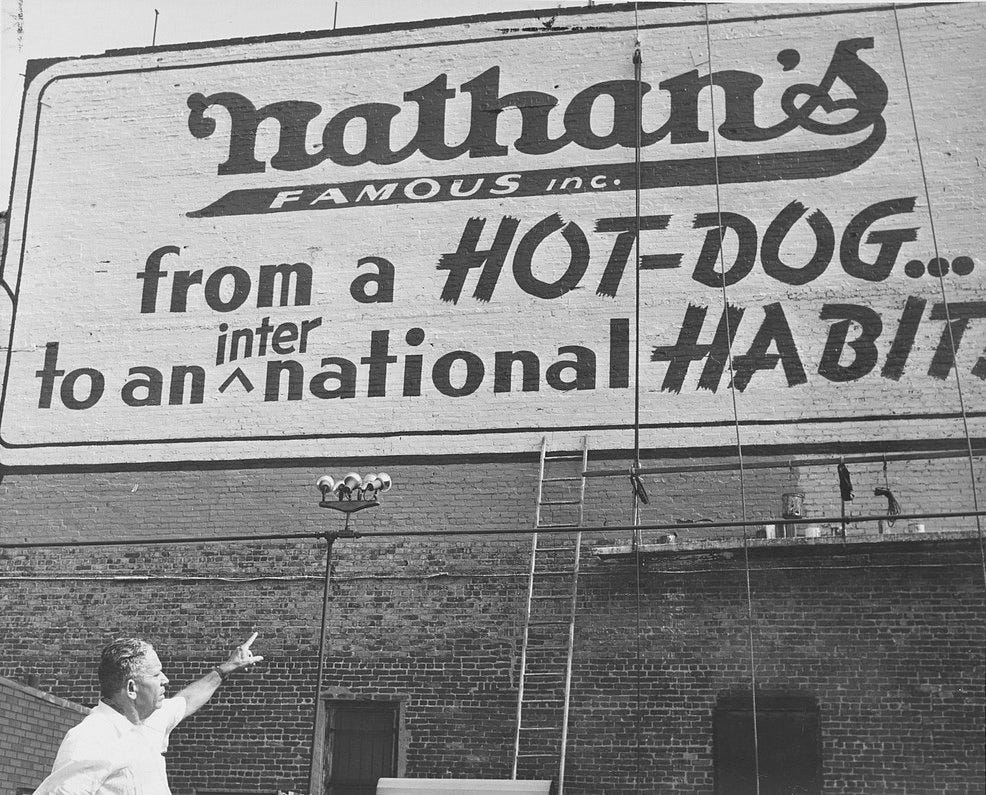
The noose of consolidation in the American food system tightened again this week, as Nathan’s Famous — the Coney Island hot dog stand turned national icon — was absorbed by Smithfield Foods. Smithfield, in turn, has been owned since 2013 by China’s WH Group, the largest pork processor on earth, which acquired the company explicitly to secure reliable access to US meat supply.
Smithfield already controls roughly a quarter of American pork production and a sprawling share of processed meats that move invisibly through grocery stores, stadiums, schools, prisons, and fast-food counters. Adding Nathan’s locks another cultural brand — and the calories behind it — inside a global protein portfolio optimized for efficiency, export, and financial return.
This is how vulnerability accumulates in advanced societies; through years of consolidation that remove redundancy while preserving the illusion of abundance. When disease, trade conflict, sanctions, shipping disruptions, or capital stress arrive, there are fewer independent producers left to absorb the shock. There are only choke points.
Over a century ago, Nathan Handwerker used his $300 in savings to feed a neighborhood. Today, the same food passes through multinational ownership structures whose priorities have nothing to do with local resilience. Maybe the hot dogs will still taste familiar, but the system behind them is anything but.
(And perhaps, to digress slightly given the strategic importance of the food system to this nation, scriptural food laws have never been more relevant.)

One of the earliest and most impactful articles written by the team here at Collapse Life — The endless freedom of the open road — spelled out the disaster modern automobiles have become. In it, we noted older cars are the key (at least for now) to preserving truly private mobility.
Now, the paradoxical ‘mobility-as-prison’ has just made another leap forward. Automotive ‘kill switches’ are coming.
This week, an amendment led by Kentucky Congressman Thomas Massie tried to cut off funding for so-called “advanced impaired-driving technology,” the emerging class of systems designed to watch drivers, infer when they are impaired, and intervene.
The amendment, which failed because enough Republicans crossed the aisle to keep the pipeline intact, wasn’t about whether kill switches are already required (they aren’t). It was about whether Congress would slow the regulatory machine set in motion by the Infrastructure Investment and Jobs Act, which instructs the Department of Transportation to design a future mandate. This vote said: proceed.

Supporters say this is all about safety, prevention, and lives saved. And while some of that is true, it isn’t the whole truth. Once a machine is allowed to monitor behavior and override human agency, the question is about where judgment lives and what happens when systems get handed control over the choices we make.
“Kill switch technology will not be confined to one narrow purpose, no matter what its proponents believe or claim,” said Clyde Wayne Crews of the Competitive Enterprise Institute in a statement. “We must oppose this erosion of civil liberties and not set this precedent for government monitoring of everyday Americans.”
To wrap up this week’s Notes, we have to circle back to Davos and touch on the signals that came out of the World Economic Forum, which this year (minus the obvious Bond villain Klaus Schwab), seemed extra-deplorable. The title of our Thursday story summed it up well, however there is one additional and important point of cringe.

Our friends at Zerohedge picked up on it and they were right to point it out: Larry Fink Says Public Has Lost Trust In Davos Elites And He Blames “Capitalism.”

Without delving into the obvious absurdity of having Fink — the head of BlackRock — opine on the current state of trust in “capitalism” (which, let’s face it, is anything but free market), it’s the undercurrent of the comment that should send off red flags in your head.
The contrived opposite of capitalism in America at the moment is “socialism” — Zohran Mamdani being the most prominent spearhead of that movement, governing (ironically enough) in the world’s capital of finance. Make no mistake, the movement has plenty of other comrades waiting in the wings as more and more “trust“ in the current system disappears and these actors step in to placate an increasingly desperate public.
Fink is alluding to that. But just as with the Soviet Union, the governing class never feels the pinch. It’s the bottom 90 or 95 percent who suffer; bereft of any form of wealth, reliant wholly on the State, and subject to the whims of their rulers, who do not care one iota about their wellbeing.
It’s worth reminding: That’s you. And that’s us.
Collapse Life is all about helping you cut through the fog, to protect yourself and your family. But help your neighbors and friends wake up to reality and prepare, as well. When the titans of industry are telling you the very system they’ve mastered is no longer working for them, that’s a strong signal to pay attention — something big is coming.

This week’s ‘Book Chat’ continues the conversation on Dmitry Orlov’s ‘Reinventing Collapse.’ Join us - the livestream starts at 12:30 ET!
I think my auld karr is now getting maw valubill. Sorry, there were a lot of wrds, and I could only understnd the middel bit.
More seriously. Great read, Thank you as always.