

No fertilizer. No farmers. No food.
The system that feeds the world runs on natural gas — and, thanks to a war no one wanted, that system is starting to break.
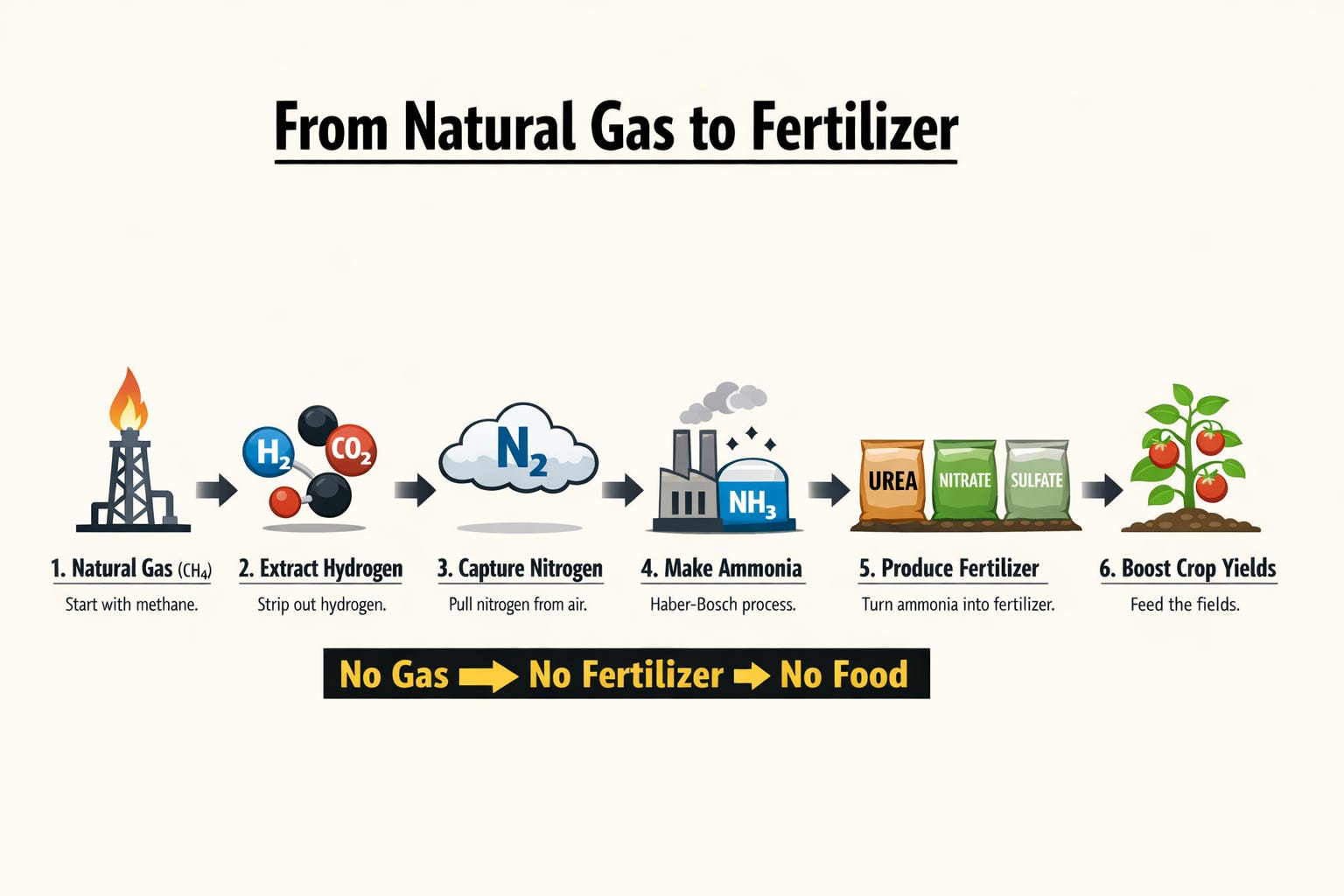
Fertilizer is made from natural gas and natural gas is now inextricably linked to geopolitics.
You wouldn’t necessarily know we’re on the brink of a food crisis when you pop down to your local grocery store. Most things are still on the shelves. Sure, there are a few holes here and there, but by and large, the abundance appears to remain unscathed.
At least, for now.
What most Monday morning quarterbacks and the armchair pundits who like all-caps posts on Truth Social don’t understand is this: everything that underpins their lifestyle is currently on the verge of being irreparably broken. But don’t take our word for it.
We love the folks at Capitalist Exploits — Chris MacIntosh is one of the smartest investors and geopolitical analysts out there, especially when it comes to energy and commodities. His most recent piece, entitled You Can’t Print Fertilizer, is a masterclass in the taxonomy of this train wreck we’re witnessing. He writes:
Everyone is glued to oil prices right now. Lines at the pump. Flights grounded. Dubai in chaos. And the financial media is doing what financial media does...obsessing over the thing everyone can already see.
What they’re missing is the second order.
And the second order is where empires actually fall.
He’s 100 percent correct. Natural gas is where the real chokepoint exists and that’s because, for better or for worse, roughly half of global food production depends on synthetic fertilizer.
We don’t feel it yet because there’s a lag that occurs as systems break down. But the devastation adds up quickly: as warehouse stock dwindles, as farmers make decisions on what to plant based on the inputs they can (or can’t) afford, as formerly globalized food producers guard their production (and food security) more closely by reducing or eliminating exports, each and every node of the supply chain we’ve come to take for granted begins to evaporate.
MacIntosh again:
Here’s what makes food different from every other supply shock: you cannot restart the harvest. Miss the planting window and you wait until next year. That’s not a quarter you revise. That’s a season gone. Bangladesh, Pakistan, India...roughly two billion people, a quarter of the planet...are already facing fertilizer shortfalls going into planting season.
The system we’ve known for the past 50 (or so) years — the one that runs on an industrial scale, with industrial inputs, tuned for maximum output at the lowest cost, and absorbing inordinate amounts of abundant energy — just came to an end.
What remains to be answered is what happens next. Do we return to an older form of agriculture, one which, while perhaps not as energy dependent, is heavily dependent on knowledge and skills? Those just happen to be two things in very short supply in the West, where we have tossed the small farmer to the dung heap and gutted out farming communities. Another alternative is going down the route of synthetic food — lab grown, bio-hacked, and engineered to fuel, not feed. Could that be what fills the vacuum nature abhors — a Soylent Green solution to a crisis that didn’t need to happen?

It’s true, as MacIntosh says, you can’t print fertilizer. All the pressures listed earlier — reduced yield and output from farmers, food inflation, even the potential for rationing — create volatility and instability in a society that was once the envy of the world for its food abundance and access.
As we often say here at Collapse Life, the demise doesn’t come Hollywood style; it’s a slow grind. So don’t be fooled by the illusion of abundance we still see on shelves — that might very well prove to be temporary and we may witness those living paycheck-to-paycheck slip into something more dire.
Meanwhile, the madmen who rule this world sit down to tables abundant with the choicest morsels. It’s worth remembering these so-called leaders don’t do their own shopping, cook their own food, or give a hoot about the plight of the little guy. We’re not being emotional, we’re just calling it as we see it.
Given everything that’s happening, we bet you never look at natural gas the same way again.
Susan Harley and Zahra Sethna touched on this very topic in last week’s book chat — i.e., the uncomfortable reality that the system feeding billions depends on a handful of fragile inputs.
This Sunday, we shift from diagnosis to practical action: ways to think about food, resilience, and what comes next. If you like to eat and you have ideas to help others feed themselves, be sure to join us live. Subscribe to receive notifications.
I hate to be the fly in the ointment, but has the world forgotten what manure is meant to be used for?... The biggest problem civilization currently faces is not war, and it's certainly not a disruption to the petroleum industry... It's the corporatization of our global food supply... Buy some chickens and raise them for food and to fertilize the small backyard garden that one should be growing... If raising and growing food isn't realistic, then join a food bank or form relationships with independent farmers as a source of healthy food... Whatever it is that one can do... DO SOMETHING to stop being such pitiful slaves to modernization and the factors that seek to control every aspect of our lives, including what we eat.
Mexican sunflower is an excellent organic source for nitrogen.