

Burn it down; a mantra for our times
With forests and churches actually burning down, pop culture’s current fixation on fire and purification echoes Silicon Valley’s accelerationist drive to burn down the old order.

More than 300,000 people in France and Spain have been evacuated in recent days as "erratic and unmanageable" wildfires continue to scorch thousands of hectares of land. Hundreds of wildfires are burning across Canada as well, from British Columbia to Nova Scotia. Several major wildfires also continue to burn across Colorado and Utah, triggering evacuations, road closures, and large firefighting operations; fire crews in Britain are tackling what they say are some of the worst wildfires ever seen in England, Scotland, and Wales.
At the same time, suspicious fires have destroyed churches across America, from Maine to Buffalo to Astoria to Chino, California, and that’s just in the last few weeks.
Fire is in the air and, as it turns out, in your face, in so many strange ways.
*****
At the World Cup final halftime show, Shakira performed the competition’s official anthem, “Dai Dai,” wearing a costume that strongly mimicked flickering flames.
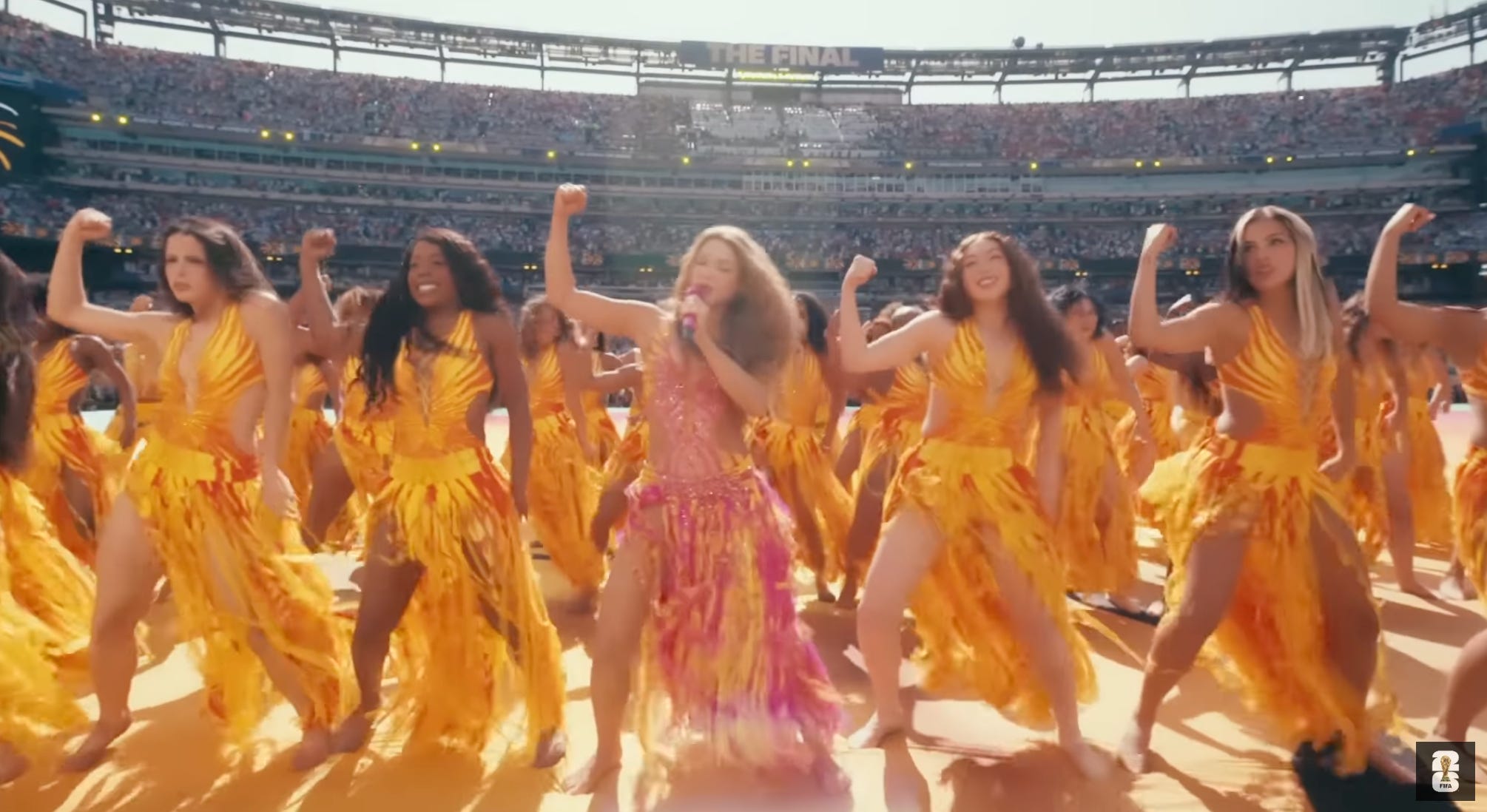
You are the owner of that firе
No one can take it away
We’ve taken all that our hearts can hold
And we can’t hold on to the past no more
Dimitri Oswald, who runs the Reality Revolt channel on YouTube has a chilling 1:30 video on the Masonic symbolism of Shakira’s videos, including her World Cup performance.
Meanwhile, Katy Perry’s newest single, released on June 25, 2026, is entitled “Watch It Burn.”
Tonight's the night, I light a match
Throw it hard behind my back
Gonna try to forgive and forget
Light a cigarette, and watch it burn
In the music video, Perry breaks out of a hospital burn unit, grows a scorpion tail, and goes on a fiery rampage, torching a newsstand stocked with fake magazines titled Gaslight Magazine, Alpha, and Slop Times. She walks past a sign reading, “Read Between the Head-Lies,” while screens in the background flash a breaking alert: “Don’t Believe Everything You Hear.”
The entire episode ends with Perry crashing into a church, where she sheds her scorpion tail and is thrown into a baptismal pool.
In the ‘behind-the-scenes’ video posted above, Perry can be seen talking to someone off camera and saying, sarcastically, “You’re used to sinners coming back… I’m back. I’m here to get saved. My mom’s been praying for it for a long time.”
Back in 2014, when Perry made a music video depicting the ancient gods of Egypt, she told Rolling Stone, “Listen, if the Illuminati exist, I would like to be invited!”
*****
If you accept that pop culture is used to prime the public for certain future realities, then you can start to see why this article is drawing parallels between wildfires, arson attacks on churches, and songs about burning down the established order.
Tracks like Perry’s “Watch It Burn” can be described on a personal level as being about her need to renew herself after leaving a toxic relationship. Societally, the same narrative represents a culture that has moved past the desire to “fix” outdated and broken institutions. The message is clear: some structures, frameworks, and systems are too corrupted to reform. The only way forward is a total structural reset — burning down everything so that, from the smoldering ashes, the phoenix can rise.
The “burn it down to rebuild” sentiment echoing through pop culture is not happening in a vacuum. We’ve talked about this previously as it relates to implementing technocracy, most recently, with Courtenay Turner. This is the powerful philosophical shift we're living through, as Silicon Valley, with its endless access to data and money, is now blatantly and openly shaping public policy with a doctrine known as accelerationism.

While pop music expresses this feeling through emotional anthems of purification by fire, technocrats and policymakers are translating it into literal strategies to dismantle, bypass, or fast-track institutional collapse. Destruction as a necessary cleansing step before rebirth is basically the foundational concept of Effective Accelerationism (e/acc), a concept advanced by tech founders like Marc Andreessen, Garry Tan, and Martin Shkreli.
A 2023 New York Times article described it as follows:
Effective Accelerationism (often shortened to “e/acc,” pronounced “e-ack”) is a loosely organized movement devoted to the no-holds-barred pursuit of technological progress. The group believes that artificial intelligence and other emerging technologies should be allowed to move as fast as possible, with no guardrails or gatekeepers standing in the way of innovation.
Rather than trying to reform legacy systems like banking, public transit, or healthcare, the goal of e/acc is to let technology render them obsolete overnight. Proponents believe the friction of collapse is a necessary price to pay to force society into its next evolutionary stage.
*****
Pop culture serves as the psychological engine that makes this destructive transition palatable by glorifying disruption, framing systemic failure as a beautiful act of “purification,” and normalizing a high-tech future as completely inevitable. The public is conditioned to cheer for the rule-breaking “disruptor,” a narrative archetype that tech leaders gladly inhabit to bypass democratic oversight and public policy. And those of us honest enough to admit it, bear witness to this hubris virtually every day, whether Musk, Thiel, Karp, Zuckerberg, or any of the other self-appointed disrupters happily burning down what we all once took for granted.
Shakira’s “Dai Dai” anthem emphasizes a different kind of flame — an internal, personal fire that global systems cannot take away. In public policy and Silicon Valley, this translates directly to the aggressive push for hyper-decentralization, which holds that if centralized legacy institutions (central banks, federal governments, legacy media) are corrupt or failing, technology must provide the tools to bypass them entirely. This is driven by decentralized protocols, sovereign computing, and crypto-economic networks.
These ideas have moved from fringe internet theories into mainstream public policy. El Salvador’s Bitcoin experiments were early indicators, but the current trend includes local governments exploring decentralized physical infrastructure networks (DePIN) for power grids and internet access. It is the policy equivalent of the pop anthem: pulling power away from a failing collective entity and placing it into a distributed, unquenchable network of individuals.
The hardest part of accelerationist ideology to sell to the public is the inevitable friction, pain, and chaos of letting legacy systems collapse. Pop culture solves this by reframing destruction not as a tragedy, but as a beautiful, necessary cleansing. When Katy Perry sings about lighting a match and watching the past turn to ash, or when Shakira channels raw, destructive energy, they are tapping into a collective desire for a clean slate.
By dancing to anthems about burning things down, audiences subconsciously reframe the terrifying prospect of institutional failure as a form of personal and collective therapy. It shifts the public mindset from “We must protect our institutions” to “Let’s see what happens if they fall apart.” Pop culture primes the public to cheer for the individual who breaks the rules, which perfectly clears a path for tech companies to bypass public policy under the guise of "innovation.”
*****

The Katy Perry story has an even more… interesting chapter, let’s say: the highly publicized relationship with former Canadian Prime Minister Justin Trudeau, which came to the public’s notice during the World Economic Forum meeting in Davos.
You cannot script a more perfect example of the “pop culture to technocracy pipeline.”
Trudeau, the perfect feminist male woke globalist, leaned into the track’s branding directly. He appeared in viral social media videos dancing and hopping along to “Watch It Burn” to help hype her new single. No indication he was wearing blackface, however.
Perry has explicitly framed “Watch It Burn” as a tool for moving past her multi-year relationship and called-off engagement with Orlando Bloom. If Bloom represented the old, traditional Hollywood fairy tale, Trudeau represents a step into a hyper-connected, political-celebrity paradigm.
By using fire as a symbol of purification to torch the emotional remnants of her past, she isn’t just singing about structural destruction — she’s actively living it by immediately pivoting to a relationship with a prominent political figure. And so, while technocrats and modern political figures may want to style themselves as rockstar “disruptors” to gain public favor, the Perry-Trudeau romance actually represents the inverse: the literal merging of pop celebrity and institutional power.
*****
In reporting on this subject, there was a purposeful effort not to stray into the very obvious cross-pollination with biblical prophecy, in particular some of the important females that feature in Revelation. Those females who lead the pop culture charge to burn things down — not just Katy Perry, not just Shakira, but Madonna, Taylor Swift, Lady Gaga — look, feel, and act much like what the apostle John described in that important eschatological writing. Nevertheless, it might be worth delving into in a future article.
The unprecedented wildfires and church arsons we’ve been seeing recently are physical manifestations of an accelerated reset. They act as tangible symptoms of a society being systematically burned to the ground. Mirrored by pop culture and social norms, these events represent a deliberate demolition of existing institutions at multiple layers as a means to clear the path for a very different, very disturbing technocratic future.