

What Amsterdam’s new ad ban signals about 21st-century liberty
Amsterdam says banning ads for meat, flights, and petrol cars gives people “more freedom.” But when the state starts curating desire in the name of liberation, the burger poster is only the beginning.
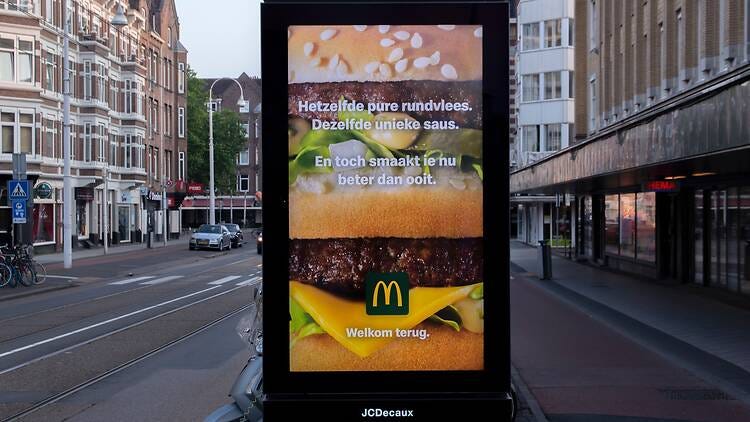
If you stand at a tram shelter in central Amsterdam this month, the colorful, glossy billboards that usually punctuate a modern European commute are no longer there. No images of thick, juicy beef burgers; no deeply discounted weekend getaways to Ibiza; no diesel-powered SUVs helping you escape to the country or family-friendly cruise ship holidays.
On May 1, 2026, Amsterdam officially became the first capital city in the world to enforce a legally binding ban on public advertisements for products that promote a “high carbon” lifestyle, such as meat or petrol-powered vehicles. The move builds on a rapidly growing global trend, following in the footsteps of neighboring Dutch cities like Haarlem, which became the first in the world to outlaw meat advertisements in 2024, and UK hubs like Edinburgh, which passed a landmark ban targeting ads for high-carbon aviation, SUVs, and fossil fuel companies.
Amsterdam’s measure, driven by a coalition of the GreenLeft party and the Party for the Animals, targets city-controlled public spaces — including its billboards, bus stops, metro stations, and tram shelters. The objective was explicit: align the city’s physical streetscape with its ambitious goal of achieving carbon neutrality and halving local meat consumption by 2050.
To proponents, getting the ban passed was a historic triumph. They frequently refer to it as their “tobacco moment” for the climate crisis. Advocates have stepped forward to defend the policy against allegations of authoritarian overreach. Chief among them is Anke Bakker, the politician from the Party for the Animals who instigated the restrictions. Speaking to the BBC, Bakker argued that the ban is not a paternalistic effort to tell people what they should and shouldn’t eat:
“Everybody can just make their own decisions,” she said. “Actually we are trying to get the big companies not to tell us all the time what we need to eat and buy. In a way, we’re giving people more freedom because they can make their own choice instead of putting it in their face.”
Put another way, no one is prying burgers from your gullet. Citizens still possess the total freedom to eat meat or buy gasoline-powered cars. The state is simply freeing its citizens from the subconscious psychological manipulation of multi-million dollar corporate advertising campaigns. By removing the temptation, the state is restoring the consumer’s authentic free will.
Essentially, they are saying: ‘corporations shouldn’t be allowed to manipulate you into doing things… that’s OUR job!’
There was a time when liberty meant individuals were trusted as autonomous agents. You were expected to encounter competing, messy, and adversarial messages — say, a fast-food ad right next to a public health warning — and use your own critical faculties to make a decision for yourself.

Now, however, there’s a new model in which your environment is curated by authorities so that your choices automatically become “healthier,” “safer,” or “more sustainable.”
There’s an exquisite double-speak at play here: You are being freed from manipulation by having your information environment manipulated on your behalf. The state assumes the role of an invisible architect, deciding which of your desires are “authentic” (eating less meat) and which are “manufactured” (craving a cheeseburger), and then adjusting the physical world to filter out the latter.
This exposes a glaring political and economic contradiction in what the state deems “harmful.” If the ban is strictly a mathematical response to carbon footprints, then the explosive growth of artificial intelligence, data centers, and digital infrastructure should logically face the same public censorship. AI data centers consume astronomical, ever-increasing amounts of water and electricity. Indeed, a recent study highlighted by Universiteit van Tilburg’s Univers magazine revealed that the massive tech data centers operating across the Netherlands now consume a combined volume of energy equal to nearly two million Dutch homes.
Yet, as far as we can tell there are no municipal bans on advertising cloud computing or generative AI tools.
So why the double standard?
Maybe because a billboard for a juicy burger is a highly visible trigger on a public street. A data center humming in a secure corporate compound outside the city, quietly straining the national energy grid to train a large language model, is abstract and invisible to the average voter. Furthermore, high-carbon legacy sectors like agriculture and automotive are politically expendable to urban progressives; AI is viewed as the untouchable engine of the future economy.
The battleground for civil liberties is no longer just about overt bans or explicit prohibitions; it is about who controls the architecture of our daily lives. By keeping products legal but engineering them into invisibility, governments can claim they still respect individual rights and liberties while structurally manipulating people toward a pre-determined outcome.
As public spaces across the West continue to be scrubbed of “harmful” ideas, a haunting question needs to be asked: If we accept that the state must curate our environment to ensure we make “correct” choices for the planet, what happens when the authorities change their minds about what those choices are?
Get your Happy Meal while you can. If the government has its way, the Happy goes away.
The most harmful idea -- one that I hope more people scrub from their own consciences and temperaments -- is that a monopoly-violence institution, a coercive civil authority, an imposed social order, a.k.a. "government," is good or even a so-called "necessary" evil.
I’m sure this will work as well as all the paper straws in plastic cups. Or the canvas grocery bags full of produce and packaged goods in plastic.