

All aboard the pain train
Rising fuel costs aren't currently impacting Americans' need to drive. That begs the question: how much more room is left for households to adapt?
On Sunday, Iran’s Parliament Speaker, Dr. Mohammad Bagher Ghalibaf, taunted Americans on social media, after the US announced it would begin implementing a blockade of all maritime traffic entering Iranian ports.
“Enjoy the current pump figures,” he wrote, alongside a Google Maps screenshot showing gas prices near the White House. “With the so-called 'blockade', Soon you'll be nostalgic for $4–$5 gas.”

He then shared a cryptic equation, which market analysts and social media users took to mean that a compounding, non-linear price spike would result from increasing the severity of the Hormuz blockade.
Historically, $4.00 per gallon is the psychological tipping point where more than half of drivers report they would change their driving habits or lifestyle. We’re already past that point.
The national average for a gallon of gas is currently around $4.15, a 38% increase since the Iran war began. However, the pain is not distributed evenly: In Illinois and the Northeast, rates have already surged to $4.25+ per gallon. Prices in the South remain slightly lower, averaging $3.77 to $3.90, but are rising daily. For those driving transport trucks, the situation is even more dire, with diesel prices hitting as much as $5.68 per gallon.
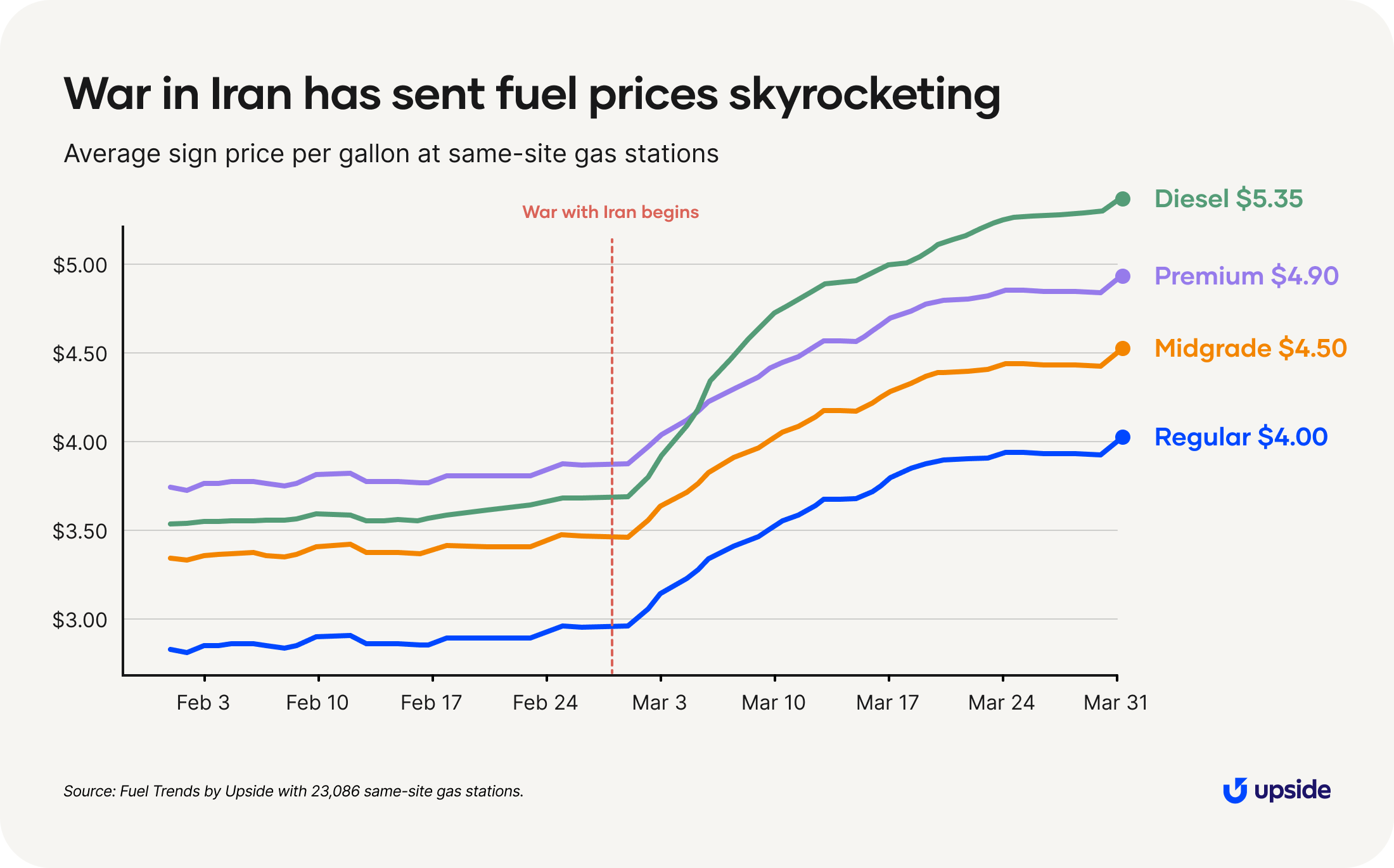
The average household is projected to spend roughly $857 more on gasoline through the end of 2026 than previously forecast, according to the Stanford Institute for Economic Policy Research — a projection made when Brent crude was still expected to ease and the Strait of Hormuz to reopen in early April. Both assumptions now look fragile.
For households living paycheck to paycheck, even a $100 monthly increase can force immediate trade-offs: less food, fewer outings, postponed plans.
These are the early adjustments, the visible ones. What’s less visible is what isn’t happening.
Economists typically expect a lag — a period in which consumers experiment with small changes before making larger, permanent ones. But the early data from this latest spike suggests something different. Fuel transactions actually rose 9% in March, according to Upside, even as prices climbed.
“The impression that people would change their behavior because of high gas prices is right,” said Thomas Weinandy, Upside’s principal research economist. “But rather than buying less gas, consumers try to reduce the sting of huge totals at the pump by making smaller transactions more frequently.”
In other words, Americans are not driving less. They are paying more, and managing the shock in smaller increments.
In theory, high prices impose discipline — or, as the saying goes: 'The cure for high prices is high prices.' That’s because demand drops and the system begins to rebalance. But that mechanism depends on flexibility — the ability to drive less, to shorten commutes, to opt out. For many, that flexibility has quietly disappeared.
Over time, the structure of daily life has hardened around mobility: longer distances between home and work, more time idling in traffic, few (if any) transportation alternatives, and a geography that assumes constant movement. For most, driving is not optional — it’s a fixed condition of daily living.
So, when prices rise, budgets tighten elsewhere. Purchases are broken into smaller pieces in order to cope. The system absorbs the shock rather than releasing it, and the pressure builds. Inflation becomes more persistent because one of its natural brakes is no longer functioning. Household finances grow more brittle because essential costs are being met with less margin for error. The longer it continues, the less likely any eventual adjustment is to be gradual.
Seen through that lens, Ghalibaf’s post reads less like a taunt and more like a test — how much strain can the system take when the usual escape routes are no longer available? It seems like we may soon find out.
It's almost as if the average family couldn't afford the Chipboard McMansion, the 3 year German Auto Lease, and the 4 years of student loans for their liberal arts degree?? But it is $5/gallon gas that they can't afford and its going to ruin them? Let them complain, but do not dare point out the reality of their situation. They will hate you for it.
I'll be 72 this month, and both of my parents were members of "The Greatest Generation"... they experienced the utter economic and social brutality of the great depression, and the rationing and uncertainty of WWII in real time as children and young adults (my dad fought in the Pacific Theater of War as a Combat Engineer in the Army's Americal Division)... I can't even imagine how difficult those times must have been... But I can imagine this... How ashamed they would be of their fellow countrymen of today with the incessant sissy-ass bitching, moaning, and groaning over something as trivial as gas prices, and whether or not they would be able to go on their summer vacation to Yellowstone this year. As much as I miss my mom and dad, I'm glad they didn't live long enough to be ashamed of the whiny little bitches that Americans have become. jmo