

You are the carbon they want to remove
How governments restrict the movements of ordinary people to prevent forest fires, but protect the industrial systems reshaping the forest itself.
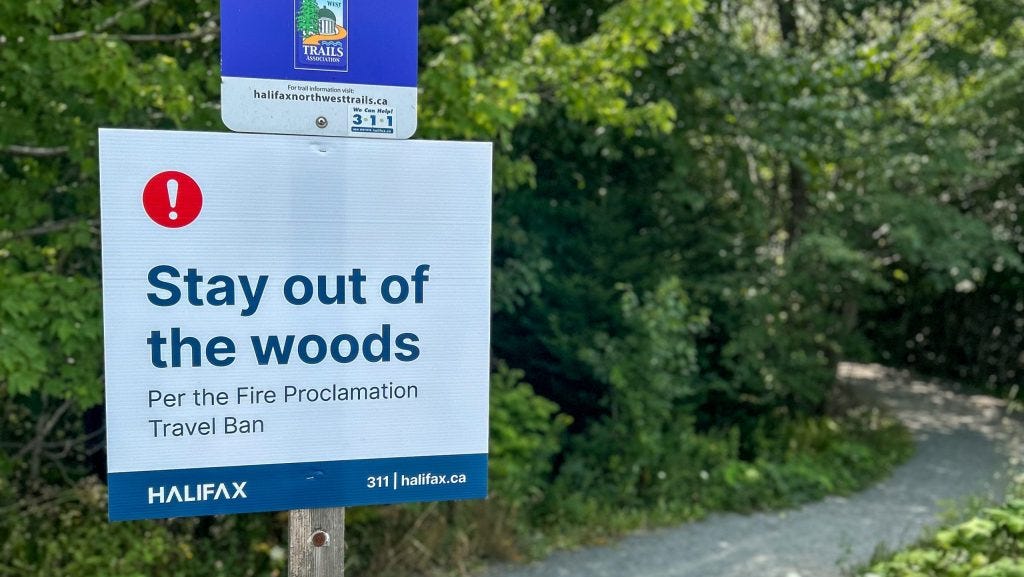
Last summer, during a two-month long drought in Nova Scotia, a province on Canada’s east coast, the public was told the forests had become too dangerous for human presence.
As memories of the province’s devastating 2023 wildfire season still lingered, Premier Tim Houston’s government invoked sweeping emergency powers, and effectively banned citizens from entering “the woods.”
The definition was so broad it extended far beyond dense forest. It suddenly became illegal to enter marshes, rock barrens, trails with some tree canopy, even sparsely wooded areas. Busy-body ‘Karens’ — some of whom even installed trail cameras — helped conservation officers monitor access points marked with yellow police caution tape, while emergency alerts and signs on highways warned residents to stay out. Violators faced fines beginning at $25,000, climbing to nearly $30,000 once court costs were added.
The message was clear: ordinary human activity itself is an unacceptable fire risk in an era of climate instability.
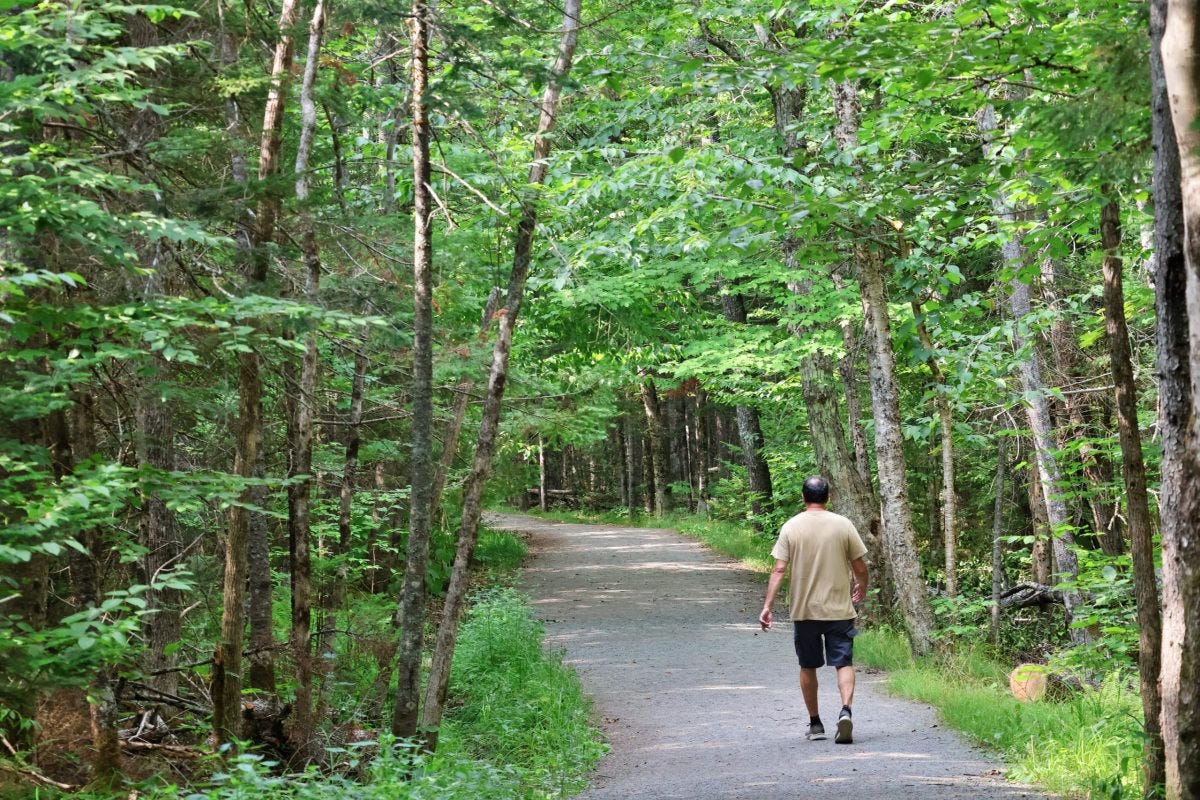
But while hikers, fishermen, campers, and tourists were being locked out of the landscape, a very different kind of activity was allowed to continue inside those same forests. That’s because the ban largely exempted industrial forestry operations. In some areas, those operations include helicopters spraying forests with glyphosate — the controversial herbicide at the center of years of lawsuits, scientific disputes, and growing public concern over links to cancer and ecological harm. The irony could not be clearer — humans were the dangerous impact, not the chemical sprays of industry.
What emerged in Nova Scotia last summer was not simply a debate about wildfire prevention. It was a revealing portrait of how modern governments increasingly interpret environmental risk through the behavior of ordinary people. The contradiction could hardly be starker. People walking quietly along a wooded trail were the public threat, but an industrial helicopter dispersing a potentially toxic herbicide across thousands of acres remained classified as forest management and so for them, it was business as usual.
For decades, industrial forestry practices in North America have transformed diverse mixed forests into tightly managed softwood plantations optimized for commercial yield. Broadleaf species like birch, maple, and aspen are often viewed as undesirable competitors because they slow the growth of commercially valuable conifers destined for pulp, lumber, and export markets.
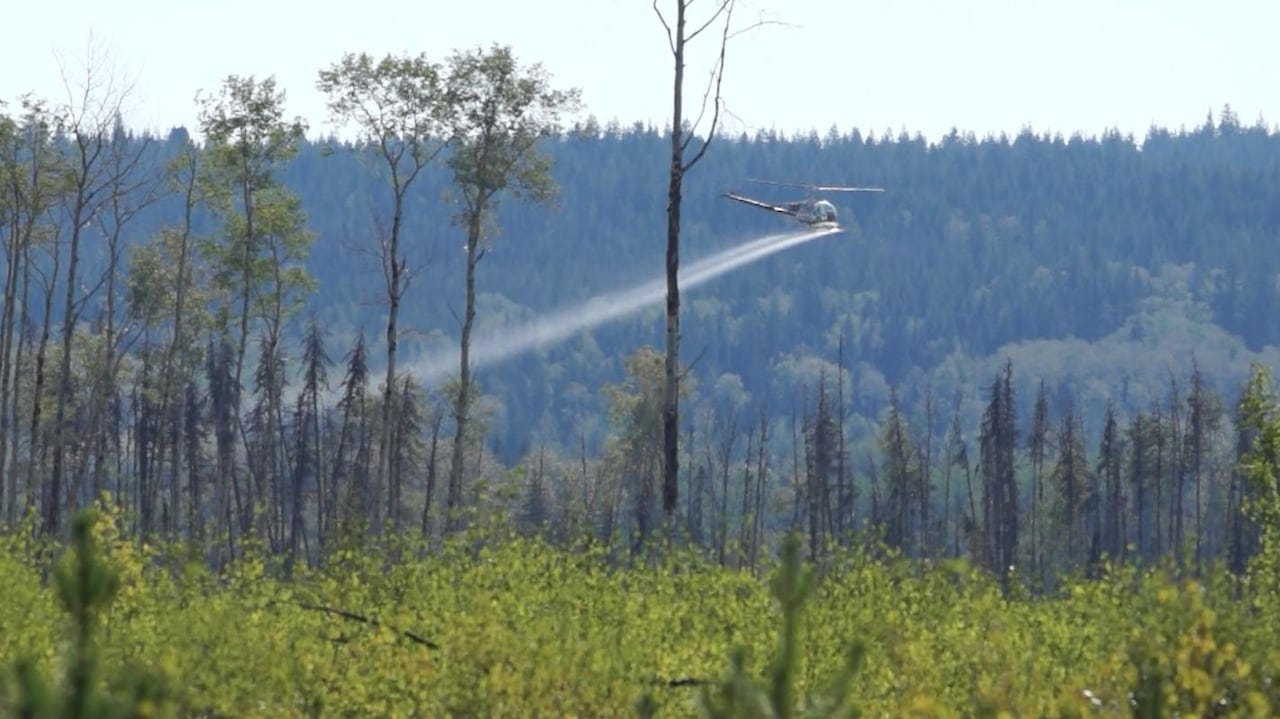
Glyphosate spraying became one of the tools used to eliminate them. A recent investigation by Mother Jones highlighted how forestry spraying programs across North America continue at near-record levels even as public concern over glyphosate intensifies and legal pressure mounts against manufacturers like Bayer.
The Forest Service and private loggers say they use glyphosate because it helps commercially attractive conifers like pine and Douglas fir rebound faster after fires and timber harvests. It does so by killing deciduous trees, native shrubs, flowering plants, and anything else that might compete for water, nutrients, and sunlight. In short, a key rationale for spraying a disputed chemical in natural settings boils down to executives and regulators treating forests, including our national forests, as tree farms.
But mixed forests do not behave the same way in fire conditions as dense conifer monocultures. Broadleaf trees tend to retain more moisture, interrupt canopy continuity, and burn differently than tightly packed softwoods. Scientists and environmental groups have long warned that this practice alters forest composition in ways that heightens wildfire vulnerability, noting that monoculture forestry can create landscapes simultaneously more efficient economically but more fragile ecologically.
The immediate aftermath of aerial spraying may also leave behind large amounts of dry organic debris across the forest floor, creating additional combustible material during drought conditions.
In other words, the same industrial processes justified as “managing” the forest likely contribute to making it far more combustible.
Yet public messaging rarely focuses on the structure of industrial forestry itself, instead putting the responsibility entirely on individuals. Closing “the woods” in Nova Scotia last summer was reportedly because of the danger posed by human presence: a cigarette, a campfire, a spark from an ATV, a hiker simply stepping into the woods.
The system creating the broader ecological conditions remained politically untouchable until last month, when the contradiction eventually collided with the courts.
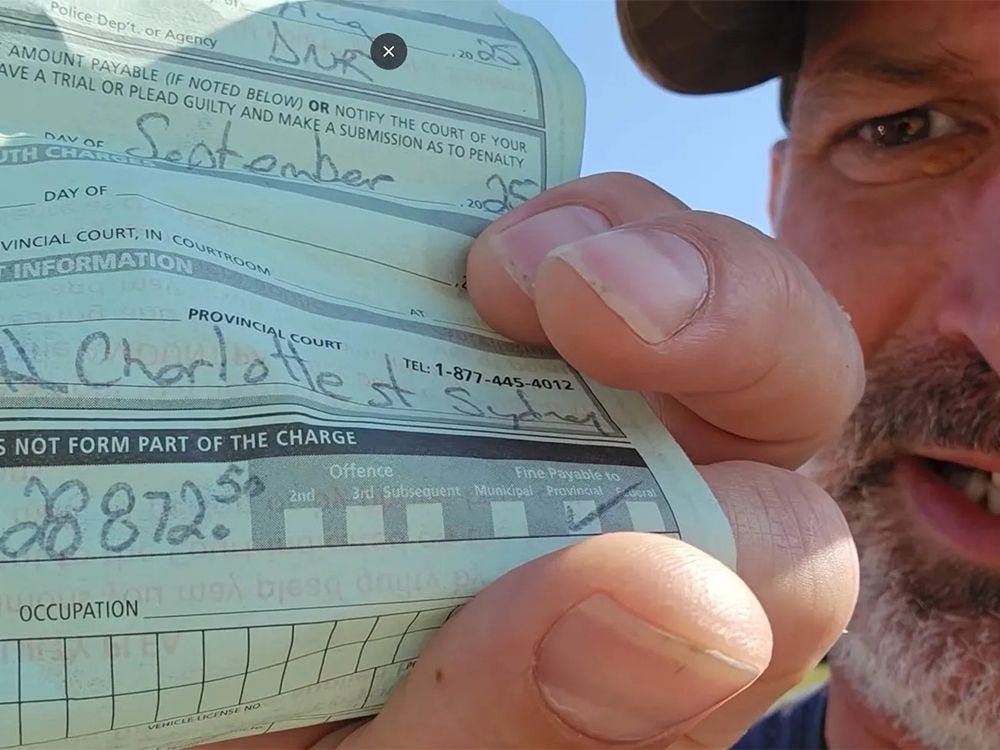
On April 17, 2026, the Supreme Court of Nova Scotia struck down the woods ban following a constitutional challenge launched by Canadian military veteran Jeffrey Evely, who intentionally violated the restrictions in the presence of police — an act of peaceful civil disobedience — in order to receive a citation, by doing so having legal standing, and thus forcing judicial review.
In a sharply worded ruling, Justice Jamie S. Campbell found the order “unreasonable,” noting that the province’s definition of “the woods” was so vague that citizens were forced into absurd interpretive exercises simply to determine where they could legally walk.

More damaging still, court proceedings revealed that provincial authorities had failed to meaningfully consider the Canadian Charter of Rights and Freedoms before implementing the restrictions. According to reporting and legal filings surrounding the case, commercial forestry interests had secured operational exemptions while ordinary Nova Scotians absorbed the burden of the emergency measures.
Despite the important constitutional rebuke, the ruling passed with relatively little national attention compared to the wall-to-wall global media coverage the original emergency declaration garnered. The emergency alerts, press conferences, and fear-driven messaging surrounding the ban reached millions. The court decision invalidating it arrived quietly, many months later, through scattered headlines and a lengthy if somewhat convoluted, judicial ruling.
Premier Tim Houston responded to the ruling — not with retreat or regret — but defiance, telling reporters he “would do it again.”
That statement may ultimately reveal more than intended: Nova Scotia’s woods ban was never just about wildfire prevention. It reflected a broader governing instinct increasingly visible across the Western world. Large centralized systems are treated as necessary and legitimate even when they generate systemic fragility, while ordinary decentralized human behavior is recast as the primary source of risk.
The citizen is the hazard; the industrial monoculture a critical business interest. The hiker is restricted; the helicopter continues to its deadly overhead spraying.
When a perversion like this takes hold, governments gain extraordinary power to regulate daily life under the banner of public safety. There were many, many people in Nova Scotia who gladly complied with the ban. There were many citizens who gladly snitched on their fellow citizens. But the most unsettling lesson of all? The ability for democratically elected governments to speak the language of ecological stewardship, while protecting the very systems that simplify ecosystems, erode resilience, and increase dependency on industrial and chemical intervention.
When one activity is framed as environmental stewardship while another becomes a punishable public threat, it’s no longer merely a contradiction. We’ve entered the age where the human has become the problem — and that means all of us eventually become expendable.
> The emergency alerts, press conferences, and fear-driven messaging surrounding the ban reached millions. The court decision invalidating it arrived quietly, many months later, through scattered headlines and a lengthy if somewhat convoluted, judicial ruling.
Similar to how the U.S. government announces huge job growth for the month, before quietly revising downward the numbers later.
There was a period of time after I became collapse aware where I used to go and drink and get high in the woods whilst awaiting the end of civilization. It's a big part of why I got into foraging and can now identify so many species and grow so many of them.
Anyway, during that period if I had encountered a flimsy plastic sign from a bank telling me to stay out of the woods that sign would not have been there any longer. There's a good chance it would have given me something new to drunkenly forage for resulting in the extinction of those signs from the entire area.