

The new WEF Global Risks Report confirms what everyone already knows
Leave it to the useless elite to publish a report written by Captain Obvious, supported by research from Prof. Sum Ting Wong.

If you’ve been paying attention, there’s nothing surprising in the World Economic Forum’s newly released Global Risks Report 2026. The world, they tell us, has entered an “age of competition,” defined by weakening multilateral institutions, rising geopolitical confrontation, and compounding economic, technological, and societal risks.
The report is based on surveys of more than 1,300 “experts” across government, business, academia, and civil society, and it shows that pessimism is now the dominant outlook. Get this — half of respondents expect the global environment to be “turbulent” or “stormy” over the next two years and only one percent anticipate anything resembling calm. Who do you think those folks are, and what university are they teaching at?
The report describes a world in which economic tools are increasingly deployed as instruments of national security, accelerating fragmentation across trade, finance, and technology systems. (Paging Captain Obvious!) Multilateralism, once the stabilizing architecture of globalization, is described as “in retreat,” with governments prioritizing unilateral advantage over collective problem-solving. It’s notable that the World Economic Forum, the institution synonymous with global coordination, panel discussions, and buffet lines for poached lobster and Dubai chocolate parfait, is now openly acknowledging the system for which it acted as midwife is likely going to need a C-section.
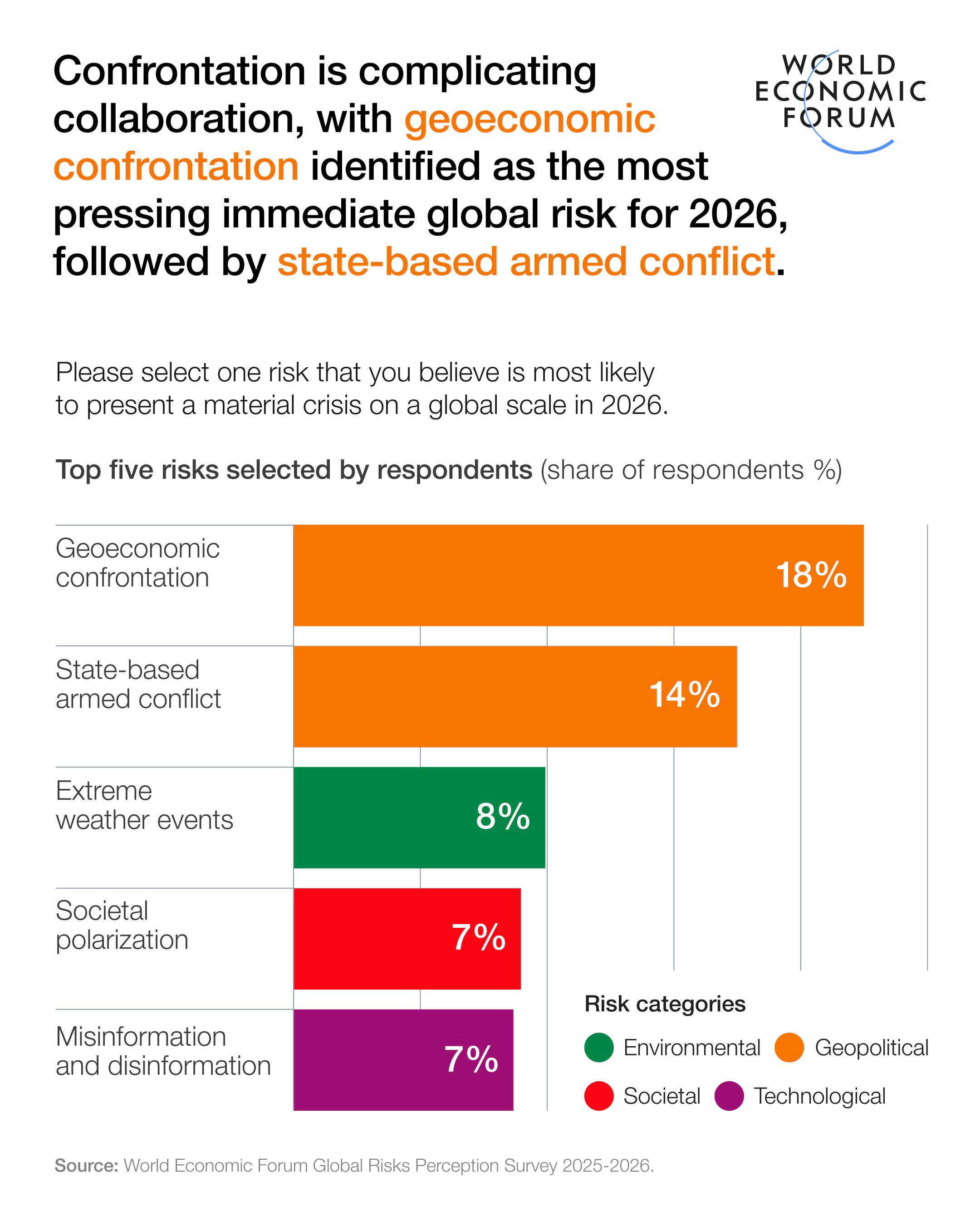
Of course, there’s another way to read the report — one that depends entirely on who “we” is. If you read between the lines, the ultimate message is clear: financial crashes, conflict, and social breakdown are coming and they’re going to be bad for us (the little guys), but extremely useful for those busy sketching out the next global order.
Take financial instability. A crash is framed as a danger to be mitigated, but history suggests it’s also remarkably useful. Monetary resets don’t arrive gently, after all. They tend to require a moment when the existing system is widely understood to have failed, when trust is low, alternatives feel urgent, and resistance sounds irresponsible.
Conflict, too, is treated as an unfortunate escalation. Yet chaos has always been a reliable solvent for borders, norms, and political constraints. Power vacuums have a way of attracting new managers. Wars disrupt supply chains, redraw maps, justify surveillance, normalize emergency powers — and, yes, reduce populations. After all, nature abhors a vacuum. The report calls this “instability” but planners call it rebalancing.
Social polarization? Here again, the framing is instructive. Division is the problem; cohesion is the solution. And cohesion, in practice, increasingly means compliance. When societies are fractured enough, the cure is obedience. The state steps in as referee, arbiter, and highest moral authority. Disagreement becomes extremism (or worse, terrorism). Skepticism becomes risk. Unity becomes something you’re expected to demonstrate, not debate.
Seen this way, the report reads less like a warning and more like a playbook with checklist.
Which raises an awkward question: how dumb do they think we are?
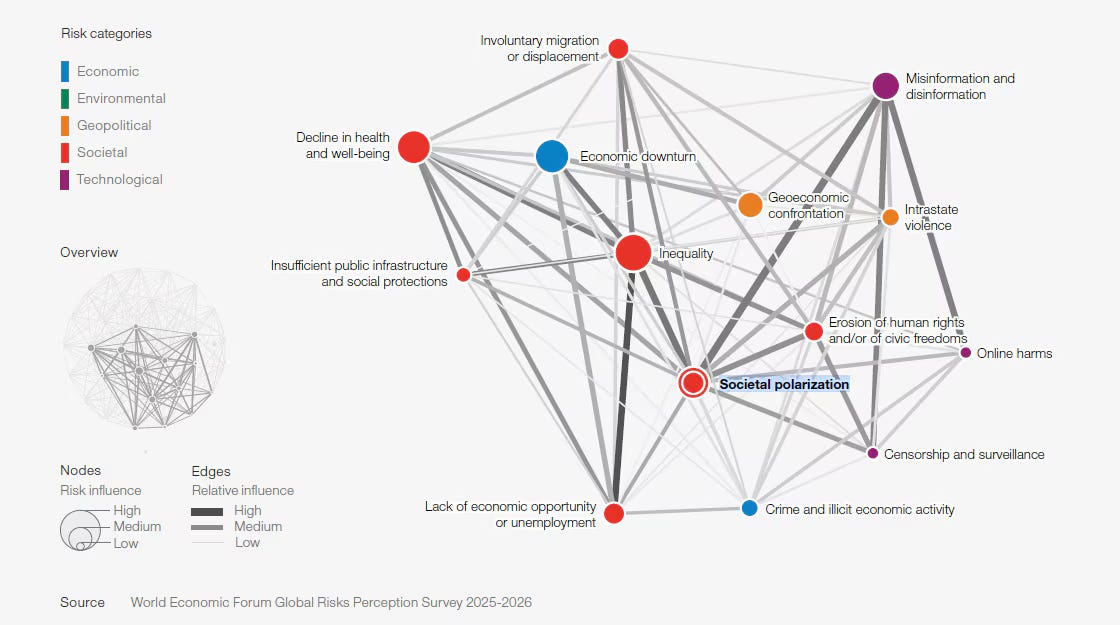
Do we really need 1,300 experts, heat maps, Likert scales, and glossy charts to tell us that debt-fueled systems collapse, that empires weaponize trade, that technology centralizes power, and that crises are used to “reset” arrangements that no longer serve those at the top?
From a Collapse Life perspective, this is why an otherwise trivial report actually matters — it confirms an old pattern. What’s framed as risk from below is what opportunity looks like from above.
The danger isn’t that the architects don’t know what they’re doing. It’s that they do.
Download the report here:

"The world, they tell us, has entered an “age of competition,” defined by weakening multilateral institutions, rising geopolitical confrontation, and compounding economic, technological, and societal risks."
Hey look everyone, our efforts to destroy the world are going great! This survey from all the governments we own and control to enact our nation wrecking initiatives says so! —WEF Executive Memo to Staff
This type of report is part of the system that weaponizes the peer review process.
This is how it works:
You invite people whose ideology agrees with yours to submit a "paper" that supports your premise.
Authors get a free publication without having to pass peer review and fluff up their CV. They get showcased as an "expert" by a "prestigious" organization. This justifies appointment as editor to journals to further entrench ideologic capture of academic journals.
You get a tailor made set of support papers to justify your opinions that you can trot out to fabricate a consensus because all the experts agree.
In the "publish or perish" environment of academia, if you do not toe the line, you will not get published. You don't get funding. You don't get graduate student research papers to enhance your list of publications. You don't get tenure. You get replaced by researchers that will play the game.
This ideologic capture dissuades any research that doesn't agree with your ideology. It weeds out any appearance of dissent.