

We don't need a revolution to break the system — just about 3-4% of mortgages
A thought experiment on power, leverage, and why we aren’t as helpless as we think.
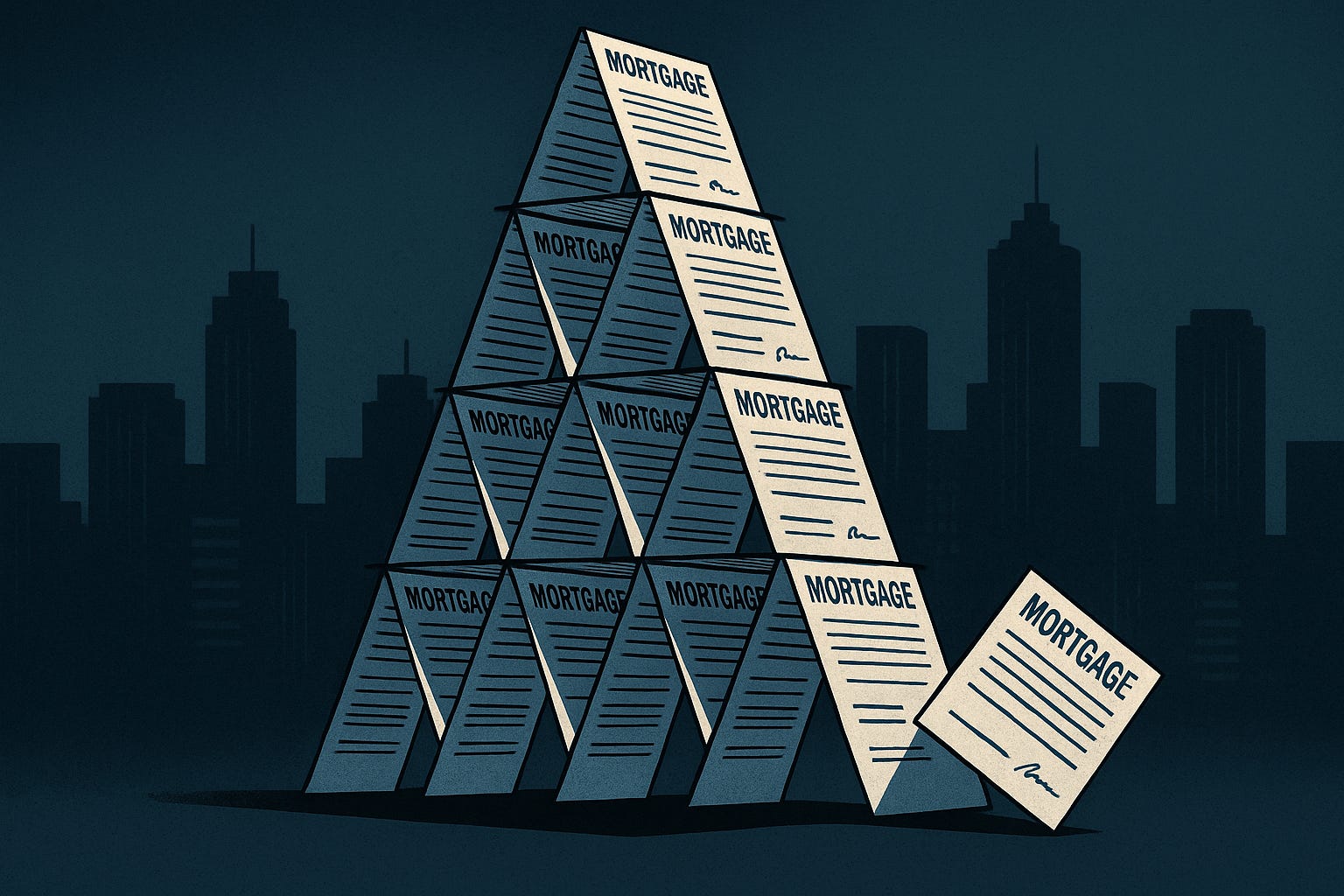
Here at Collapse Life, one heading in our business plan ‘goals’ is: “Opening people’s eyes.” We left it broad so we could encompass the myriad crises heading our way faster than a freight train, whether that’s creeping authoritarianism, financial overreach, digital control, or bureaucratic doom. And that’s just the tip of the iceberg.
When the message does get through to folks as to the magnitude of the problem, the next question always seems to be:
“But what can we actually do about it?”
Most people assume the answer is: nothing.
In many ways, that’s true. Much of what’s unfolding at breakneck speed can now no longer be stopped, and we’d be foolish not to prepare for the changes that are coming. But there are places where the system shows itself to be far more vulnerable than it would have us believe.
In a recent interview with Hrvoje Morić on Geopolitics & Empire, Substacker Michael Ginsburg made a blunt point: you can’t fight the system using its own tools. You can’t vote your way out of this or sign enough petitions or go to enough protests to bring down technocracy. If something were to effectively shift the balance, it would have to come from another direction entirely.
He then offered a purely theoretical observation — not a plan or a proposal, but a clever insight — to remind us of where modern power structures absolutely cannot tolerate instability: finance. That’s the beating heart of everything, and where a strike at the fat cat global cabal would hurt the most.
If a large enough group of people stopped paying their mortgages, he noted, the banking system would snap. (And yes, we know the banking system is going to snap in order to usher in the Great Taking, but note that it’s on their timeline not ours. Ginsburg’s thought experiment entertains the idea of an economic collapse before they’re ready, thus forcing them into some chaos and disarray.)

When you break down the numbers, it becomes clear he has a point. A very good point.
Across the Five Eyes nations — Australia, Canada, New Zealand, the United Kingdom, and the United States — it would take only a sliver of mortgage holders purposely defaulting to push the banking sector into existential trouble.
A back-of-envelope analysis using ChatGPT* showed:
United States: Just 2–4% of mortgages — roughly 2–3 million households — entering self-subscribed default would be enough to trigger systemic stress.
Canada, Australia, New Zealand: Crisis thresholds hit at roughly 4–8%, depending on capital buffers and their housing-heavy banking systems.
United Kingdom: The tipping point would be around 9% of the £1.704 trillion mortgage stock.
None of these levels are unprecedented. They’re well below the Great Financial Crisis when you account for contagion, margin calls, and unrealized losses. In other words:
the modern financial system is exquisitely sensitive to even modest, synchronized shocks.
Again — at the risk of putting us on a list — we caveat that this is not a call for financial rebellion but rather, for perspective. (HA! Who are we kidding? We’re likely already on a ‘list’!)
The institutions we live under project the image of unshakeable authority — governments, central banks, multinational lenders — yet the machinery they operate runs on balance sheets so delicately leveraged that a few percentage points of negative disruption sends the whole thing swaying.
The takeaway isn’t that anyone should try this. In fact, if an isolated household did it they would be personally devastated. These numbers only matter at scale — which places the whole concept comfortably in the theoretical realm.
The real point is that people are not nearly as powerless as they’ve been taught to believe.
If a system can be destabilized by a single-digit shock, its authority is dependent, not absolute. It survives because people choose to be compliant and quietly do what they’re told. That happened in Nazi Germany, right?
Whenever the powerful insist that nothing can be done, remember how fragile their house of cards really is. And then channel your inner Schindler!
*Note: In the interest of transparency, we include here the rudimentary prompt we put to ChatGPT: “Can you do an analysis for me. The numbers don’t have to be exact, but grab them from legitimate sources (show those in your work) to estimate the number of mortgages, should they fall into default that would create a systemic financial situation in each of the 5-eyes nations.”
Write to us at info@collapselife.com if you’d like to see the nitty-gritty output we received. Or simply create your own prompt in your AI of choice and check our work, letting us know what you found out! —Ed
15 years ago the Feds told me I owed them some money, a lot of money, from what they claimed was a flawed tax filing that went back a few years before that. I disagreed. An accountant had done the work. Unfortunately he had moved out of the country and so I didn’t have his help. And I didn’t have the money. They offered a payment plan, with interest. And tacked on all the interest and fines for the prior years. I told them to
pound sand. I made them an offer. They got nasty. I got nastier.
Full disclosure: I was a lawyer at the time but not actively practicing and knew nothing about tax law. But I did have some ‘advantage’ over someone without legal knowledge. And I learned real quick. And got some help from a friend. We developed a strategy. And contingencies. And more contingencies.
I took them to court. The court sent us to mediation. I refused the mediation settlement. Went back to court.
I probably can’t say exactly the final outcome or how we got there, and I did have to pay some money. Getting there was an emotional battle and very time consuming.
But the amount I paid was 5x less than the original amount, and I got 5 years to pay it. And there was no penalties. And no interest.
And what I ended up paying, in inflation adjusted terms, was less than what I originally offered. And the Judge knew it and he let the IRS boys know that the entire thing had been a massive waste of time.
It’s hard to fight the system. And there certainly is risk. But sometimes you just have to go at it.
I spent my life up to 35 in Canada. I remember in the 90's when the government was bringing in the goods and services tax, known as the GST. A lot of people were against it, we were already taxed heavily. My thought was the people should just refuse to pay it. What could the government do? Lock everybody up? The people have the power but are too afraid to use it. Is it because we the people don't trust each other enough to follow through and stand together? I believe that plays a part.