


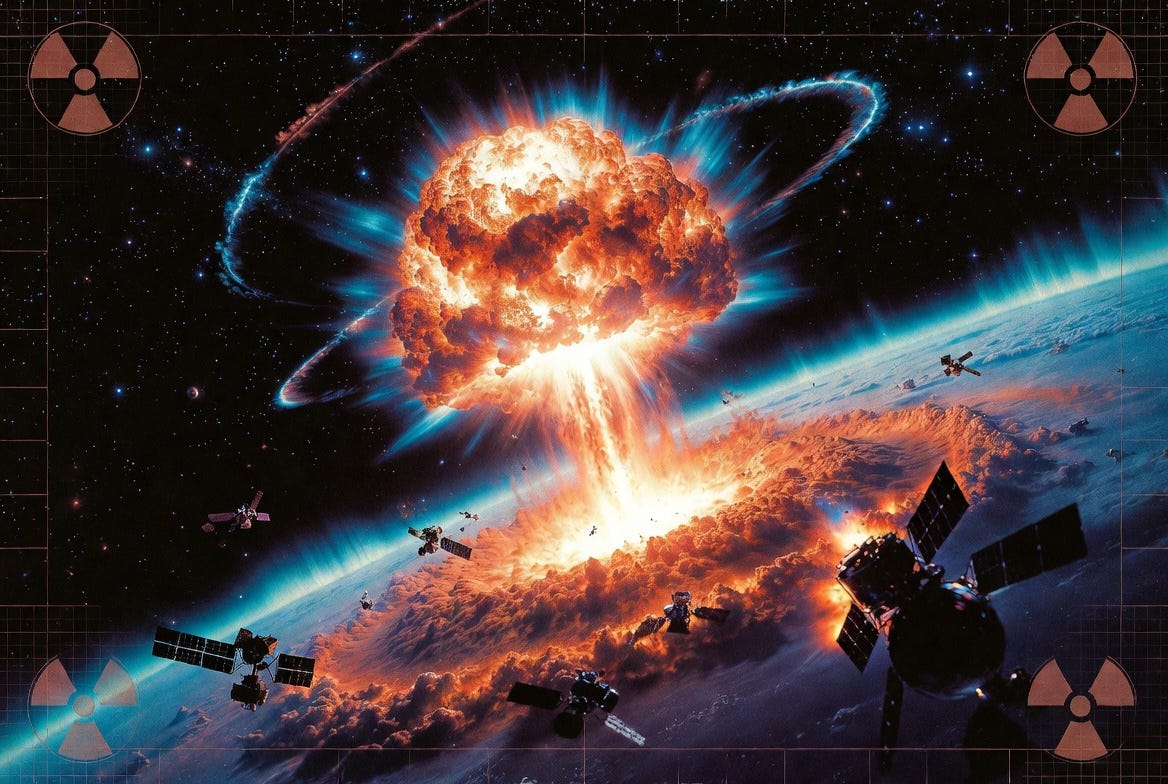
A small group of defense, intelligence, and lawmaking figures recently gathered in a suburb of Washington, DC, to imagine how they would respond if a nuclear weapon detonated in space.
In the fictional scenario, the detonation caused American satellites to fail, crippling GPS systems and wreaking havoc on financial markets. Officials were forced to wrestle with who was responsible, how quickly the United States could rebuild its satellite constellations, whether nuclear escalation could still be avoided, and how ordinary civilians might cope if the invisible systems that hold daily life together begin to go out.
While the exercise was ‘fictional,’ the market behind it is very real. This war game was organized by Fuse Energy Technologies, a fusion-energy company whose business model depends on the kind of future it was asking Washington to imagine.
Founded in 2019 by JC Btaiche, who was 19 years old at the time, Fuse is valued at more than $200 million. The company has a two-track business model — generating commercial revenue through nuclear effects testing, while at the same time developing long-term fusion power technology. By using pulsed-power machines to simulate the extreme radiation environments of nuclear reactions, they provide what they call "Radiation-as-a-Service" (RaaS) to government and the private sector.
Btaiche’s rapid ascent to this geopolitical playground carries a somewhat mysterious and distinctly cinematic quality. Born in Lebanon, he immigrated to Canada before migrating south to the heart of the American defense tech apparatus. By age 25, an age when most peers are navigating entry-level corporate jobs, Btaiche had successfully transformed himself into a trusted, high-clearance service provider for the United States military and the National Nuclear Security Administration.
So, Fuse is not some neutral convener of preparedness conversations. The rehearsal also appears to be a sales pitch. Fuse sells, or wants to sell, nuclear effects testing and radiation hardening capabilities. The tabletop scenario imagines a nuclear event in space that exposes weaknesses in satellites and other systems. The likely conclusion is not difficult to see: America needs more radiation testing, more hardened infrastructure, more resilient satellites, more simulation capacity, and more spending. That conclusion happens to point directly toward Fuse’s business model.
In February 2024, DefenseScoop reported that the Air Force had selected Fuse to develop nuclear effects testing options for military survivability and adaptability. Btaiche told the outlet that existing nuclear weapons simulators were “old and aging out,” “oversubscribed,” and mismatched to the evolved threat profile — a remarkable insight for a 20-something. He also described the contract as a modest deal to get Fuse “our foot in the door” into a projected $127 billion pool of Defense and Energy Department programs for nuclear simulation, nuclear effects testing, and fusion pulse power over five years.

That foot in the door quickly became a massive footprint. In April 2026, Fuse opened a multi-million-dollar radiation testing facility in Albuquerque, New Mexico — strategically located near Sandia and Los Alamos National Laboratories — specifically designed to relieve critical defense supply bottlenecks and scale up their testing capacity.
The company’s personnel only make the story stranger. Maura Burns, a former Assistant Director of the CIA's Weapons and Counterproliferation Mission Center, was recently appointed to its advisory board. The company’s lead engineer, Vahid Damideh, was previously one of Iran’s top nuclear scientists, where he oversaw the country’s National Nuclear Fusion Project.
Those details are not evidence of wrongdoing, but they matter because they reveal the world Fuse inhabits: former intelligence officials, nuclear scientists, defense customers, space infrastructure, radiation testing, and a Washington policy class being invited to imagine a future in which all of this becomes urgent.

“We felt like a war game was the best way to educate people,” Btaiche told Axios reporter Colin Demarest, who was offered an exclusive to cover the recent tabletop exercise. Btaiche explained that the goal was to help people “understand why the hell this matters and what the world may look like in five to 10 years.”
That admission is revealing. The exercise was not merely a neutral rehearsal for an unknowable crisis but a tool of persuasion, a way to take an abstract vulnerability and turn it into a roomful of people feeling the urgency of a market Fuse is already trying to serve.
Tabletop exercises have a long institutional history, from military war games to Cold War nuclear planning to the post-9/11 homeland-security world. They can expose real weaknesses, but they can also become a ritual through which elites rehearse disasters that the public is rarely allowed to understand until after the failures begin.
Since COVID, exercises like these have carried a strange aftertaste. Event 201, hosted by Johns Hopkins, the World Economic Forum, and the Gates Foundation in October 2019, simulated a fictional coronavirus pandemic just months before the real one emerged. Johns Hopkins has emphasized that the exercise was not a prediction, but even so, it makes many people uncomfortable to learn that institutions rehearse disasters before the public is forced to live through them.
Even if Fuse’s recent dog-and-pony show in Washington doesn’t turn out to be predictive of a real future event, it is revealing because it shows which systems insiders think are most fragile and where budgetary stockpiles are being built.
At one time, preparedness meant identifying a vulnerability and hardening the public system. Now, that same vulnerability becomes a procurement category. The failure is rehearsed, the threat is narrated, the officials are gathered, the urgency is created, and the mitigation is sold back to the taxpayers.
That is the business model of a state that has fused with the industries that service its anxieties.
An interesting scenario... makes one wonder how we'd know... did a nuclear blast in space that we can't see just happen, or did the powers that be just turn off our internet as a means of disrupting communication between the masses...??
Hmmmm……why am I remembering the show “Don’t Look Up” I feel like we are being prepped for this🤔