


Prediction markets like Kalshi are enjoying a winning streak when it comes to trading volume, thanks to events like the FIFA World Cup and Taylor Swift’s wedding to Travis Kelce. CNBC reports that Kalshi did more than $30 billion in trading volume in June.
That’s billion with a ‘B.’ In one month.
Scroll down to the bottom of that story (which most people don’t do these days) and you’ll notice a disclosure advising readers that “CNBC and Kalshi have a commercial relationship that includes customer acquisition and a minority investment.”
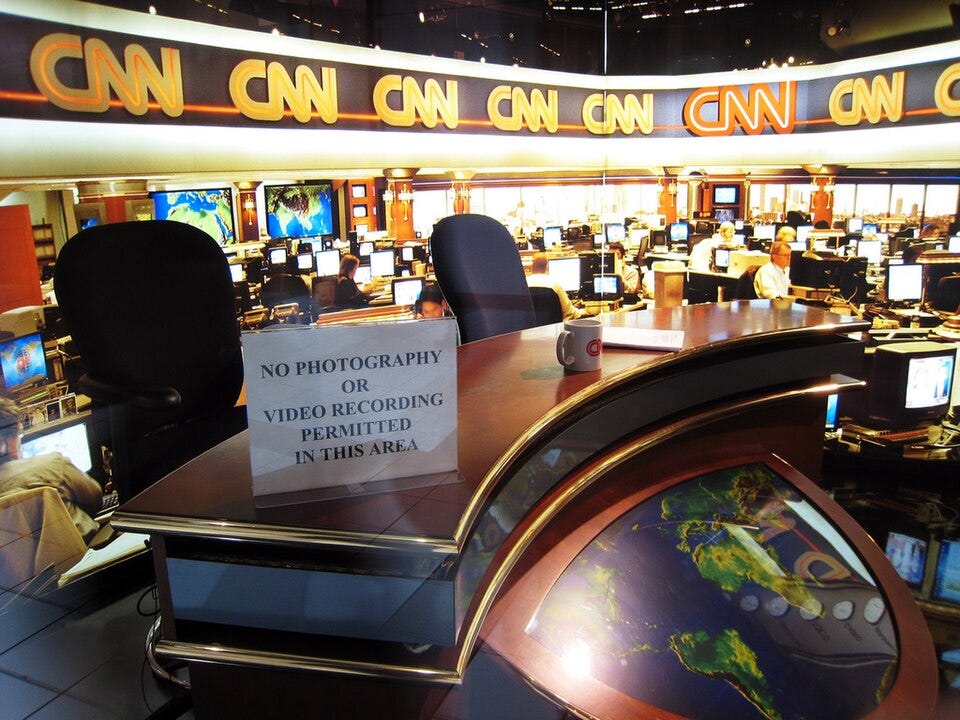
According to a new joint investigation by news sites Popular Information and Public Notice, both CNBC and CNN have been heavily promoting Kalshi, but only disclosing Kalshi as their business partner infrequently and inconsistently.
CNN has featured Kalshi in at least 115 segments of its “The Odds” feature, often with data analyst Harry Enten presenting market probabilities as usable insights. CNBC has published dozens of articles on Kalshi markets and regularly integrates them into on-air graphics and reporting. Their disclosure, when used, is written in typical legalese, but the terms of the actual partnership mean the network stands to benefit directly from converting viewers into new Kalshi users and from growth on the platform, more generally. In some on-air and online segments these ties reportedly go unmentioned.
Kalshi has described the arrangements as standard data and integration deals, while emphasizing that viewers can choose how to use the information. “People aren't dumb,” the company said in a statement after Popular Information/Public Notice released their reporting. “They hear and see these disclosures and can choose to use our data as added context or choose not to.”
Kalshi’s rival, Polymarket, has its own partnerships with mainstream media. In January 2026, it struck a deal with Dow Jones to share its prediction data with outlets like The Wall Street Journal, Barron’s, and Investor’s Business Daily. It was Polymarket’s first big media partnership, and was followed shortly thereafter by a partnership with Substack.
“Journalism is better when it’s backed by live markets,” Polymarket wrote in an X post announcing the deal. How convenient!

We beg to differ.
Journalism outlets present odds as though they are legitimate signals of what ‘the market’ thinks. A ticker across the bottom of the screen gives a ‘breaking financial-news’ façade. Hosts talk about probabilities as if they are neutral indicators rather than the output of incentive-driven markets that can be thinly traded, gamed, or influenced by the very coverage now amplifying them. And somewhere in the background, the viewer is being nudged to participate.
To be clear, that’s not better journalism.
That concern becomes even sharper when placed against the longer history of Polymarket and the national-security roots of prediction markets, traced in a new investigation by Whitney Webb and author and journalist, Mark Goodwin.
Webb and Goodwin argue that today’s prediction-market boom didn’t come out of nowhere. Long before Kalshi and Polymarket were being dressed up as clever financial tools, elements of the US national-security apparatus were already interested in prediction markets as mechanisms for forecasting, information aggregation, and policy decision-making.
According to Webb, the government’s interest began around 2000, when DARPA program manager Michael Foster persuaded colleagues to fund research into whether prediction markets could help guide public policy. DARPA, an agency of the Department of Defense, also saw another use: prediction markets might help intelligence agencies aggregate dispersed information and bypass bureaucratic obstacles. After 9/11, when intelligence agencies blamed “siloed” information for their failure to prevent the attacks, that logic became even more powerful.
The solution offered by the intelligence world was not less centralization, but more: more data sharing, more surveillance, more predictive tools, more systems designed to turn scattered human behavior into actionable signals and patterns.
Webb connects this push to the rise of intelligence-linked data-sharing and surveillance projects including Chiliad, founded by Christine Maxwell, sister of Ghislaine Maxwell; Palantir, co-founded by Peter Thiel; and Total Information Awareness, conceived and directed by retired Navy Admiral John Poindexter, who served as National Security Advisor during the Reagan administration.
Her argument is that prediction markets belong to a broader post-9/11 architecture of intelligence, surveillance, behavioral forecasting, and policy-shaping technology, and seen in that light, the media partnerships matter even more.
If prediction markets remain niche betting platforms, their influence is limited. But once their odds are piped into cable news graphics, financial news coverage, newsletters, and political reporting, they begin to shape what the public thinks is likely, credible, inevitable, or already “priced in.”
The opposite can also happen — a strange mashup of a Las Vegas casino and the UK’s ‘nudge unit’, where betting on the odds to make money shapes the public opinion and justifies ‘necessary’ action.
Media coverage can move attention toward a market. More attention can move money into the market. More money can make the market look more authoritative. That appearance of authority can then be cited by the media as evidence of what “the market” believes.
This is an incredible danger and a fundamental betrayal of the role of journalism.
Once media companies, traders, political insiders, celebrities, intelligence-adjacent networks, and retail users are all inside the same feedback loop, the market doesn’t just wager on the future — it may actually be helping to create it.
I've been out of the loop on this development. So, in other words, grand-scale betting on future outcomes, that is further legitimized and perpetuated by media, becomes self-fulfilling prophecy?
Journalism on a broad scale is mostly advocacy. They are the cheerleaders trying to push their team to victory. It is literally the tail wagging the dog.
It is the worst in the major outlets. We have a bunch of rich people's kids that are trying to bring about changes that they really don't understand to a country that they don't understand. They think that their big city environment is "real" and the rest of the country is filled with rubes who sit around with grass stems in their mouth drinking beer and ironing their klan hoods.
Using the prediction markets makes it where they don't even have to actually do any research. They can just scan through the different topics and find one that fits their narrative while they are waiting for the barista to finish their drink. Fill it out with some carefully selected social media posts and call it a day. Call a few buddies to have them throw a few bones to them for the next story.
Most of the "intelligence community" leadership are their brethren. They went to the same schools, were members of the same fraternities, and shared a similar upbringing. They can fill out their reports with data gleaned from a prediction market rather than having to actually slog through intelligence reports and talk to people. Then just pass on their narrative to their friends in the media to back up their reports.
The whole system is skewed to keep them entrenched. You have to go to the "right" schools to be considered. You have to be able to afford to go live in NYC or DC to serve out unpaid internships on their parent's money. You have to be connected politically to get your resume on someone's desk. You have to be deemed as someone who will play along with the grift.