

Behold! The everything surveillance system is nigh
What matters in 2026 isn’t how many cameras exist (there are lots!), but how deeply their data is integrated across borders, agencies, and algorithms.
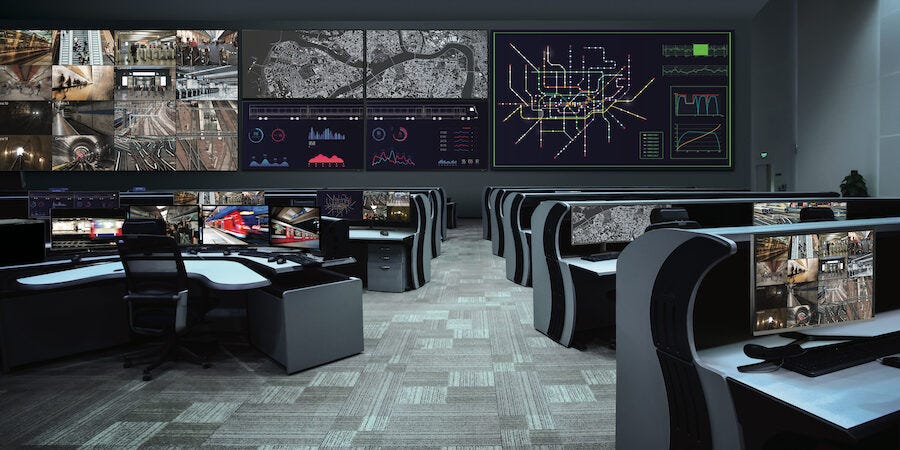
In July 2025, a global report ranked 179 cities by the number and density of government-accessible CCTV cameras. Washington, D.C., Dubai, and Stockholm topped the list.
“Washington, D.C. has more cameras per head than any major city,” the researchers noted, adding that the mayor’s office had already budgeted to triple the count. Dubai leads on sheer density — more than 2,000 cameras per square mile — while Stockholm’s high ranking is a reminder that you don’t need overt authoritarianism to build a total surveillance environment. Liberal democracies can do it just fine.
But even as the report was being digested, Mexico City rendered it obsolete. The city announced the rollout of 15,200 new “security totems,” instantly making it the most surveilled city in the Americas. Each totem carries two cameras — one fixed, one with full 360-degree vision — capable of low-light recognition of people and vehicles, all streaming live to a central command system.
That detail matters. The question is no longer how many cameras are watching you. It is what those cameras know — and what they are connected to.
Singapore’s Smart Nation program offers a glimpse of where this leads. There, CCTV networks, traffic cameras, environmental sensors, public transport systems, and infrastructure monitors all feed into centralized government platforms designed to “optimize” urban life. Traffic flow, crowd movement, waste collection, air quality, and public safety are analyzed as one integrated system. Camera feeds do not stand alone; they merge with national databases and behavioral analytics to build continuously updated models of the population.
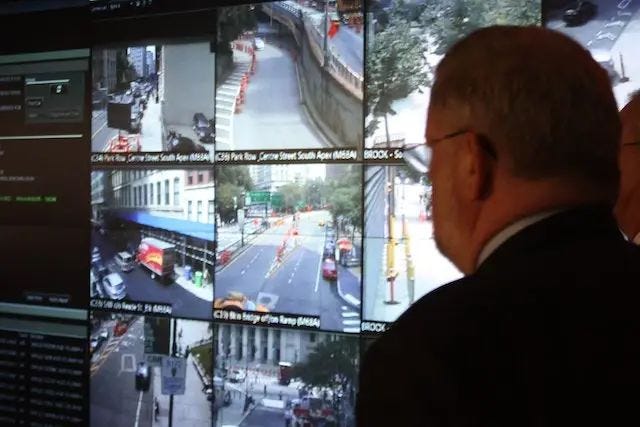
New York City has built its own version of this future. The NYPD’s Domain Awareness System, developed with Microsoft, links 18,000 CCTV cameras to one of the largest police data reservoirs on Earth — billions of license-plate reads, millions of 911 calls, arrests, warrants, summonses, complaints, and detective reports, all searchable from a single interface. It gives the city an unparalleled institutional memory: who was where, when, with what, and who else was nearby, stretching back years.
This is the real architecture of surveillance in 2026. Cameras are the sensory organs but the real power lies in the fusion — video merged with identity records, vehicle movements, phone calls, emergency logs, commercial databases, and AI-driven pattern analysis. What used to be scattered across agencies and companies now lives inside unified, queryable systems.
And this doesn’t stop at city limits. Data brokers, cloud providers, law enforcement partnerships, and multinational tech firms mean information flows across borders with far less friction than people do. Your movements in Stockholm, your purchases in Dubai, your license plate in New York, your face in Mexico City — they increasingly live inside the same global data ecosystem.
Which raises questions no mayor or police department wants to answer. Where is all of this stored? Who can access it? How long does it persist? And is there any meaningful way to opt out, correct it, or erase it?
The most surveilled places in 2026 are no longer just dots on a map. They are nodes in a worldwide system that quietly turns daily life into a permanent, searchable record.
Surveillance — once the cloak-and-dagger exploit of spies and government operatives— no longer looks like men in trench coats or watchtowers with a spotlight. It’s much more integrated into mundane infrastructure so as to obfuscate its prominence. In that way, it’s far more efficient, invisible, and pervasive. Once liberty becomes something that must be granted by that infrastructure, it ceases to be a right at all.
And Still the People Didn't See, by Geoff Buys Cars, January 2023
The first to arrive were the cameras
Installed to protect both you and me
In places where we weren't that threatened
And yet the people didn't see
What followed were traffic restrictions
To keep the roads quiet and clean
The maths didn't add up, or the science
But still the people didn't see
Next came the 15 minute neighbourhoods
Make our lives easier, decreed
To some, it seemed like restrictions
But still the people didn't see
Then came the Digital ID
So convenient, easy and free!
Your life in one chip on a mainframe
And still the people didn't see
The cars they sold were electric
All wired to the government PC
They switched off the driving on Sundays
Yet still the people didn't see
The banks moved their money to digital
The government banned cash the next week
The ability to fly was restricted
Yet still the people didn't see
They linked up your money and profile
To the ID on the government PC
Connected it to social media
Yet still the people didn't see
Then came a new cure, a new virus
Safe and Effective, and free
They linked these j&bs to your profile
And connected the government PC
When the people were locked up in cities
Policed by their digital ID
Unable to visit their loved ones
Now finally the people can see
Restricted and tracked with no money,
To go further a permit you'll need
Contained in your digital city
Oh why did the people not see?!
These steps they sold us a progress
Never looked to be quite what they seemed
If you don't ask the questions and protest
Then your children will never know FREE
It started as Good people surveillancing for Evil people.
It Ended with EVIL people surveillancing the Good People..............