

Paging Dr. Mengele: when compassion becomes murder
A century ago, Germany softened the ground for euthanasia with empathic, moral language; we know where that landed. The exact same script is rearing its head in the West.
In 1920, a German legal scholar named Karl Binding, and a psychiatrist named Alfred Hoche, co-authored a pamphlet entitled Allowing the Destruction of Life Unworthy of Life. In it, they argued for the ethical and legal justification of euthanasia for individuals deemed mentally ill, physically disabled, or otherwise burdensome to society. These lives, they contended, had lost all value for the individual and the state; ending them was compassionate and a financial and social boon.
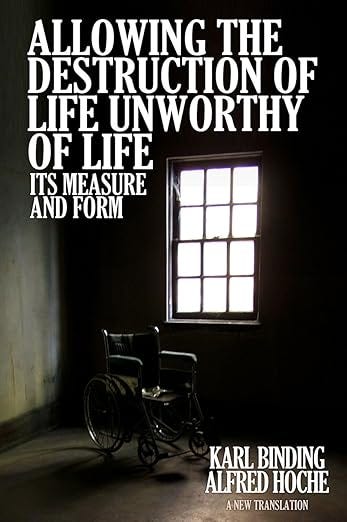
Neither Binding nor Hoche were National Socialists, or racists, and probably never imagined themselves as the architects of genocide. Yet their work became the ideological underpinning for the Nazi regime’s euthanasia program, which began in 1939 and systematically killed hundreds of thousands of disabled and mentally ill Germans. The argument that certain lives were “unworthy of living” and could be terminated for the good of society was the precedent for normalized, if industrialized, killing.
Binding and Hoche unwittingly introduced a new moral language, framing killing as “mercy,” and elimination as “care.” The unthinkable — state sanctioned murder — soon appeared as enlightened compassion. Once society internalized this vocabulary, former guardrails collapsed quietly, almost politely, without anyone seeming to notice.
This warped transformation was made easier to swallow given that Germany, after the First World War, was a nation running on fumes — its economy was shattered. People’s savings evaporated in hyperinflation. The middle class vaporized overnight. Factories stalled, unemployment soared, and food grew scarce. The Treaty of Versailles hung over the country like a curse and humiliation became its national identity. Rapid secularization and fragmentation of shared meaning deepened public cynicism.
Exhausted and demoralized, Germans stopped believing politics could improve their lives, while economic life began to feel like a zero-sum game. When resources become scarce, societies debate who is “worthy” of those resources. The disabled, the chronically ill, the mentally impaired — those who require care without producing any economic “value” — moved from protected community members to problems in search of solutions. By the late 1930s, ordinary German parents were writing to Hitler’s office asking for permission to euthanize their disabled children.
If some of these characteristics sound familiar right here, right now in America, it’s for good reason.
Across the continent, including our neighbors to the North, demoralization hasn’t come from a specific war or its aftermath, but from an endless cost-of-living crisis, a widespread drug abuse and mental health epidemic, the collapse of institutional trust, and a society fractured by corrupt politics, technology, and isolation. Culturally, many have given up hope that life will ever get better. The middle class is eroding quickly, and younger generations know they will struggle to afford what their parents took for granted. Worst of all, a majority no longer believes in a divine power and therefore no longer recognizes the spark of divinity within their fellow citizen.
It doesn’t take a global war for a country to lose hope. Debt, despair, disconnection and and a culture that has given up on anything beyond material comfort, hedonistic pleasure, and psychological ease all work just as well.
Such hopelessness allows a familiar idea to creep back into the public consciousness: If life becomes unbearable, isn’t death a form of dignity? Is it not merciful to help someone end their suffering?
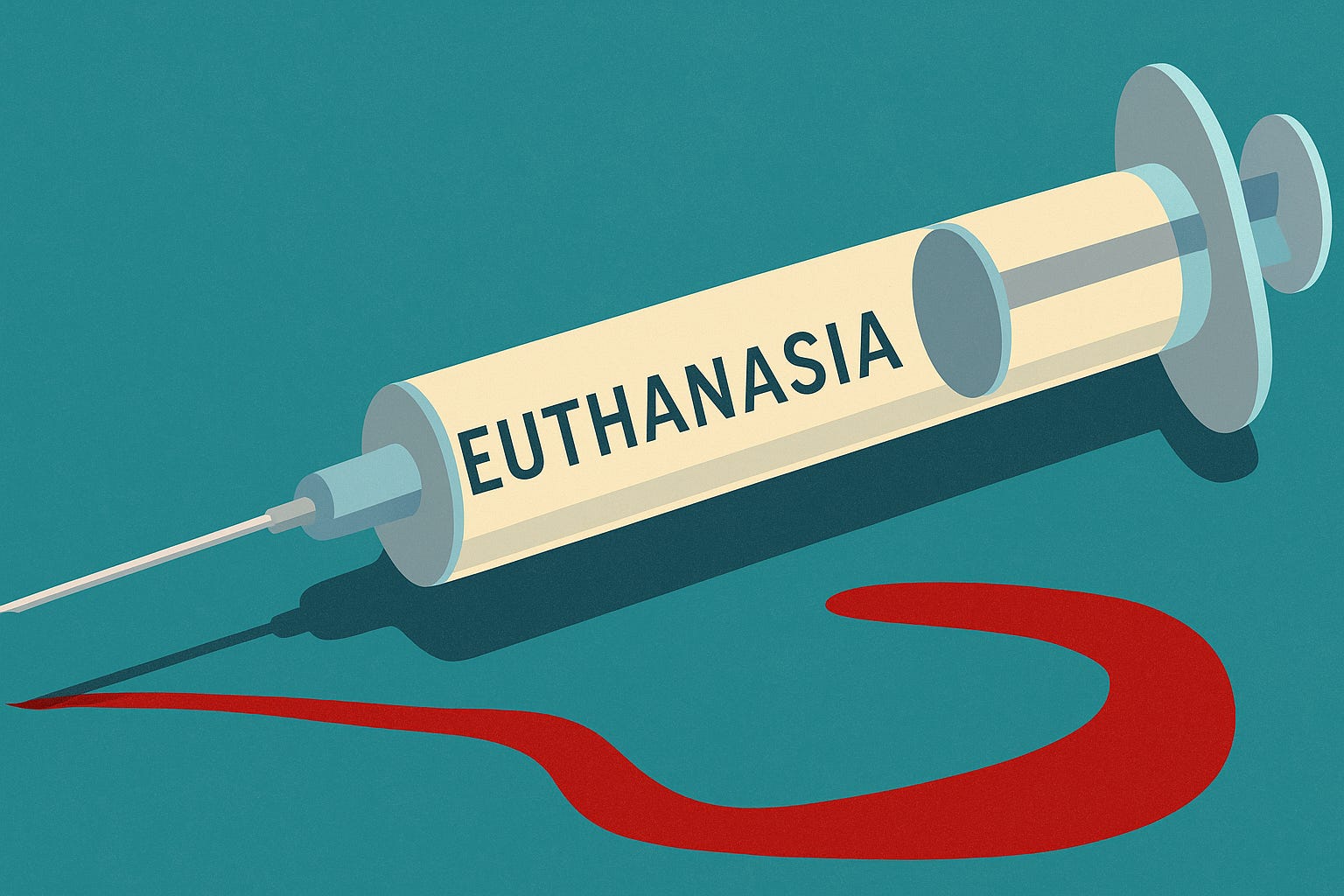
In Canada, the legalization of euthanasia — Medical Assistance in Dying (MAiD), as proponents prefer to frame it — began as a way to provide a dignified end for the terminally ill. It has since expanded to include the chronically ill, the disabled, and the mentally ill. Proposals are already on the table to extend MAiD to “mature” minors and to allow individuals to file advance requests for euthanasia before any diagnosable physical or mental disease even exists. There’s even debate in Quebec about legalizing MAiD for babies with “severe deformities.”
Some see this as a slippery slope. Others believe each step is justified. Advocates frame every expansion as empathy, but empathy has a way of morphing into efficiency when the state becomes overwhelmed and citizens become too tired to recognize the moral quagmire facing them. How did we get here?
In a word, incrementalism.
As the word suggests, incrementalism is the act of small steps towards a broader goal. One where you push just so far, step back and wait for normalization, then push further.
When a society believes the system cannot or will not take care of them, and that life itself is becoming economically impossible, something like Canada’s MAiD functions like a pressure valve for a failing state. And when people lose touch with the idea that life is sacrosanct and God-given, it becomes easier to accept the notion that we can end it at any time. Without the divine, euthanasia becomes a rational and efficient way to deal with a resource that has outlived its utility.
A clarification: Nazi Germany’s euthanasia program was involuntary and explicitly rooted in eugenic theory. Canada’s MAiD, or even Holland’s euthanasia program, is not. At least not yet.
But these societies all normalized state-provided death systemically… step-by-step. None of these populations woke up one morning and chose death as social policy. They slid toward it. Ultimately, that is the cautionary tale.
Collectively, we tell ourselves we will never repeat history’s darkest chapters. But it’s easier to recognize the return of monsters in swastikas and jackboots than it is to see the danger of policy proposals and academic papers that mistake killing for kindness. That is not progress — it’s a rebrand. Worse, it’s not just killing people, but the very essence that made us different from the monsters of history.
At a personal level, there is a fundamental right to decide to continue to fight against our inevitable mortality. But by the same token, not everyone is capable of a reasoned decision. Especially when other people are encouraging and manipulating them. There is not a good solution either way.
I think that the only viable solution is to treat any unnatural death as a homicide and investigate every case through a court trial of all people involved to be judged by a jury.
I don't believe that the state should be involved otherwise. The state should have no part in taking life, even by capital punishment. The role of government isn't to extract vengeance but to protect the rest of society. It is completely outside its purview. Not out of compassion but because it is the risk of someone innocent being convicted is too great.
Incrementalism seems to be the new strategy as Canada finalizes new hate laws affecting religious speech and freedom. It's a very powerful strategy that appears to be working in the media controlled environment. They change the language, making it sound virtuous, while omitting the incremental loss of rights and freedoms for a "greater good".
They need to censor our speech and thoughts before we know what' it's leading up to. It's a game of tricking us, inch by inch into total slavery.