

Essay: To keep or not to keep? That is the question.
We all want to stop being controlled by our possessions. But as physical books are being ingested by AI and destroyed, owning less could just replace one form of control with another.


Yesterday morning we stared (as we seem to do every morning lately) at a pile of boxes and furniture we moved out of storage and into our garage a few months ago.
At least a dozen of those boxes, maybe more, are labeled: “BOOKS.” We also have four or five antique barrister bookcases, draped in blankets, waiting to provide a home for those books.
As we work towards becoming a lot lighter and more nimble in anticipation of moving again, books are the exact opposite of light and nimble. They’re heavy and expensive to move, and you can argue that much of what’s in them can be summoned on a screen within seconds. By every practical measure, the boxes and the antiques should all go.
Years ago, while watching the dystopian film V for Vendetta, one particular scene lodged itself firmly in our minds. In an authoritarian future, where Britain has been stripped of its cultural memory, a masked rogue named V creates a hidden underground refuge filled with books, paintings, records, and films that he rescued from government eradication depots before they could be destroyed. That scene is etched into our memories. Given how fast we’re hurtling toward this type of dystopia, is it not incumbent on us to save these relics of physical culture before society reaches a point where there’s nothing left to save?
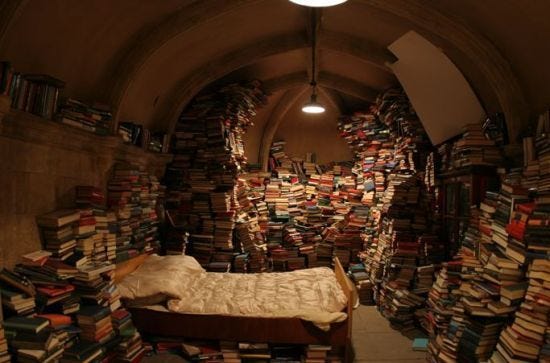
If we’re being honest, the mentality of holding on to something “just in case” is why we had a storage unit in the first place. Like many people, we kept thinking we might need these things someday. Now, we’re feeling a very strong pull from — the Holy Spirit, the universe, the great magnet… whatever you’d like to call it — telling us that someday may never come and it’s time to let go.
Despite this, the books are turning into a bigger dilemma than we expected.
Somewhere in those dozen or more boxes is a copy of D.H. Lawrence’s Sons and Lovers I was carrying when I first met Stephen. There’s a copy of On the Line that chef Eric Ripert signed for us as we celebrated our anniversary at his restaurant, Le Bernardin. There’s a two-volume set of Julia Child’s Mastering the Art of French Cooking that once belonged to my mother and still bears the crayon marks I scratched on the cover when I was a child.
The words in them are totally replaceable — they can be downloaded in seconds, found in a used bookstore, or read on someone else’s shelf. But the replacements would never contain what these particular copies do: memories.
To make matters worse, we learned recently that AI companies are buying up large quantities of books, cutting off their spines to make them easier to scan, ingesting them into their LLMs, and then discarding them.
Which means we’re back to wanting to keep all our books, as well as the bookcases that could store them, simply as a defiant middle finger to AI and the soulless future we face. But that makes us neither light nor nimble.
So, you see our dilemma?
AI companies — in an attempt to create the perfect synthetic human — want old books precisely because they predate the algorithm-driven synthetic slop that now dominates the internet. Old books are valuable because they are authentically human. AI needs to know how humans think and how they communicate those thoughts. Books do a great job of that, but once their humanity has been sufficiently extracted, they can be abandoned, not unlike old mines.
Last year, we wrote an essay about the paradox of having possessions that make you feel more prepared for an uncertain future and, at the same time, being possessed physically and mentally by those very same objects. We were essentially living out of suitcases at the time, and we wrote about the liberation that came with living small:
“Every item earns its place, which makes you reconsider what’s truly necessary.”

So is Julia Child’s recipe for salted goose truly necessary? Do I really need the copy of D.H. Lawrence’s book that I probably never finished reading because I was too busy falling in love? No. I don’t even need them as physical reminders of memories — of the moment my life changed forever, or the feeling of being a child on the floor of my mother’s kitchen. Those memories are with me whether the books exist or not.
That is precisely how possessions can come to control us.
But replacing physical possessions with digitized versions may essentially replace one form of control with another.
A physical book can be read, shared, loaned, sold, annotated, inherited, or hidden away. No one needs to enter a username and password, pay for a subscription, buy a token, or connect to the internet to explore its contents. Nobody can remotely revise it, withdraw it, edit it, or record which page you opened, how long you stayed on it, and whether or not you finished reading it.
That still doesn’t mean we need to hold on to boxes of books, or that every book inside those boxes deserves to be preserved simply because it was printed on paper. Keeping books sealed up in storage is not the same as “saving” them. A book only lives up to its potential when it sits in someone’s hands and their eyes fall on its words. It isn’t being saved by being entombed in a cardboard box because its owner can’t bear to make a decision.
So, most of ours will probably have to go, preferably to people who will open them, read them, learn from them, or at the very least, smile at what they read. The antique bookcases will likely go too. We are not V, living in an underground lair beneath the rubble of a once-great city… at least, not yet. Wherever we end up is unlikely to have room for a private library, anyway.
Some books have earned their place and will be worth the cost of moving them. Not because their contents are unavailable elsewhere, although that may be true in some cases. And not because future civilizations depend on us to preserve them. It’s only because these particular copies carry something no digital replacement ever will.
Whether Lawrence, Ripert, or Child make the cut is yet to be determined. We’ll keep you posted, if you care to know.
Ultimately, as we move into the next phase of our lives, the goal isn’t to become entirely weightless, though that would be ideal. We are beginning to understand that it would be impossible to shed everything. The goal is to curate what’s worth carrying into the future — and to trust that what we leave behind is not necessarily lost, but also moving on to its new life.
 | A guest post by
|
I prefer reading real books as my eyes get sore from too much screen time, but after I read a book, unless it's needed as a reference I'll let them go. I do have favorites that I cling to, but may have to give up one day. I buy books to support authors that I feel are exceptional or maybe controversial, on nonfiction topics that intrigue and interest me. I share them with friends and give them away.
I still know people like myself that like to read books but it seems the trend is now disappearing. Young people especially don't see the need for them. Older people, like me, seem to be reading less too, I find. It's disappointing and concerning. Sometimes I think they can't absorb it any more, or maybe just not interested and don't care.
I had a book I bought and always intended to read, about painting portraits. I still wish I had it. But why? If I ever pick up a brush again, I won’t need it.
My mom had a large stack of newspapers she collected in ‘64-‘65 pertaining to the Kennedy assassination.
We had boxes of books. I contacted every library in the area. Eventually the books were taken, but an English friend took the newspapers. Nobody else wanted them. Even American friends.