

China is winning wars and it's not even fighting
Influencers, algorithms, and Western disillusionment are reshaping the battlefield.
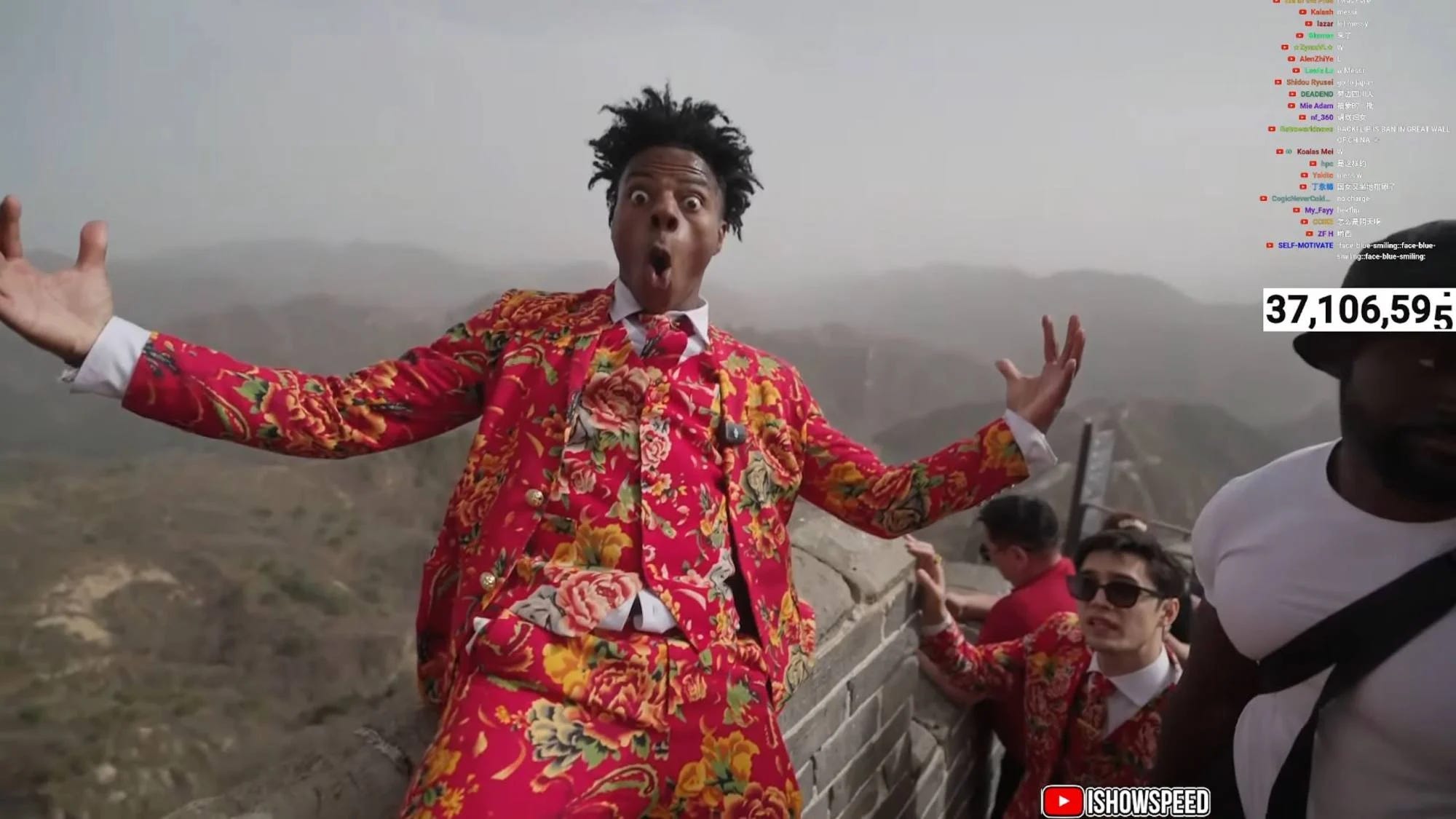
In March 2025, Darren Watkins Jr. — better known to his 52 million (!) YouTube subscribers as IShowSpeed — stood on the Great Wall of China wearing a three-piece red floral suit inspired by traditional Chinese textiles.
“Guys, I’m about to be the first person to backflip off the Great Wall of China,” he yelled to the camera, surrounded by a crowd of onlookers. Tens of millions of people watched the livestream, and as he pulled off the stunt the chat exploded.
The next day, the Global Times, a daily tabloid produced by the Chinese Communist Party, extolled the 21-year-old American streamer’s visit. They said he delivered, “an unfiltered, vibrant glimpse into China's culture, modernity, and beauty,” and offered millions of global viewers, “a fresh perspective on the country.”
As footage of his 14-day tour of China began to circulate on the internet and rack up tens of millions of views, comments sections started to echo the same stunned refrain: Where’s all the dystopia?
“After watching this video, I realized how stupid my previous views on China were,” wrote a user by the name of yanlord. “I decided to plan a trip to China this year. I think if I don't go to China, I will regret it for the rest of my life.”
Watkins never spelled out the quiet part on camera, but the subtext was everywhere: China’s a great place to be. Efficiency—check! Fun—check! Modernity—check! Cool technology—check!
Influencers like this are Beijing’s most effective PR tools. Who needs tanks, tariffs, or cute pandas, when you can woo the world by selectively showcasing the best your nation has to offer and spreading the message through social media virality?
“I am so happy about Speed’s growth as a content creator,” fellow livestreamer Hasan Piker, wrote on X during the viral visit. “It’s amazing seeing him cut through the noise and show a side of China that is rarely ever seen by American eyes.”
Just eight months later, Piker rode the wave that Watkins created and took his own trip to China, which was (of course) also livestreamed. Both Piker and Watkins said their trips were self-funded, with no financial incentives from the Chinese government. Piker’s trip was more overtly political, but the format of raw livestreams, awe at the extent of Chinese infrastructure, and a “this place actually works” vibe was very much in the same genre.
What these trips, and others like them, achieve is more than viral entertainment. They work to actively rewrite the story of China that Americans know through the Tiananmen Square massacre, forced labor among the Uyghurs, the surveillance state, the social credit system, and more.
Pew research suggests that while most Americans still have negative views of China, the share with a favorable view has risen six percentage points since last year and nearly doubled since 2023. Younger Americans have more positive views of China than their older counterparts, with about a third of adults under 50 (34%) holding favorable opinions of China, compared to just 19% of those over 50.
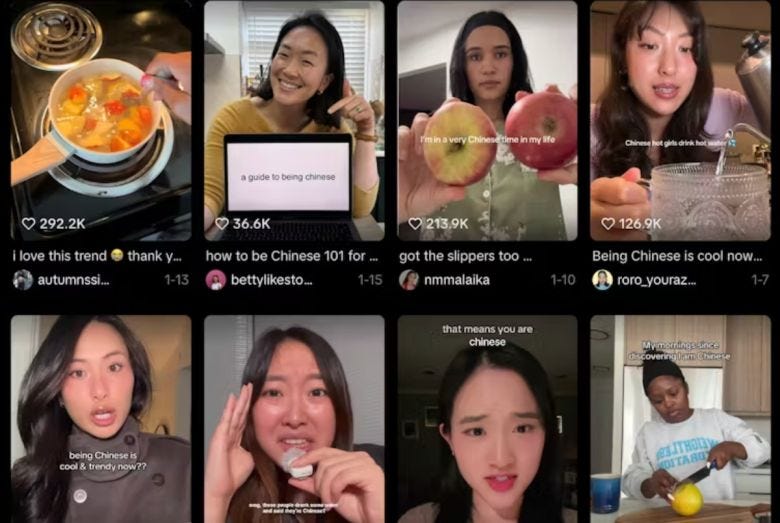
By early 2026 the effect had a name: Chinamaxxing. On TikTok and Instagram, Gen Z users began posting videos of themselves “becoming Chinese” — drinking hot water for digestion, shuffling around in slippers, queuing for congee, even adopting the occasional floral quilted jacket. NPR, The New York Times, and CNN all ran explainers on the trend, noting it reflected not just curiosity about China but deep disillusionment with American hustle culture, crony capitalism, and political dysfunction.
This is soft power at work: shaping preferences without the need for coercion. Beijing didn’t need to buy influencers like Watkins and Piker outright. It simply made the country easy and photogenic to visit, amplified their best clips through state-sponsored media gaining them millions of new followers, and let the algorithm do the rest.
Decades of “China threat” messaging in the US created broad support for tariffs, tech export controls, military spending hikes, and alliances aimed at containing Beijing. This new wave of influence tourism subtly undercuts that by making confrontation feel hysterical, outdated, or even self-defeating.
When millions of young viewers see functioning cities, polite crowds, and futuristic convenience instead of the expected dystopian nightmare, the cognitive dissonance makes hawkish policies harder to sell.
Beijing may not be trying to turn Americans into card-carrying party members overnight; the real prize is far more pragmatic. This strategy erodes the domestic political will for a prolonged, expensive confrontation, and makes the US public more willing to accept a world where America is no longer the indispensable referee.
Normalizing China as a legitimate, high-functioning alternative shifts the narrative from “authoritarian menace” to “pragmatic competitor,” while the US is visibly overextended — polarized at home, burdened by debt, surrounded by crumbling infrastructure, and exhausted by decades of forever wars.
China’s strategy of “winning without fighting” exploits exactly that fatigue. It doesn’t need to match US carrier groups or win a hot war. It just needs to make enough Americans conclude that confrontation isn’t worth the cost — while quietly locking in economic dependencies, tech standards, and narrative dominance.
The influencer trips are the human face of that. Legitimate concerns about surveillance, censorship, or coercion still exist, but the content from these creators make those seem distant, abstract, or exaggerated.
Confucius say: the empire that stops convincing has already lost.
From a Canadian standpoint China appears to be a friendly foe, one that has gained many inroads into our culture. They have actively infiltrated and influenced elections, illegal police stations, monitoring and surveilling citizens, and pushing the CCP agenda. That includes buying resources and companies to gain economic power and control.
The liberal government turns a blind eye to this insidious intrusion and it's downplayed in the media, as Carney is now giving China what it wants; a foothold, with new economic deals and concessions for "The New World Order" he talked about in his Davos speech.
With his new majority government, obtained by undemocratic floor crossings, we're on the verge of something unprecedented and very scary. They're allowing China and the WEF policies to erode the culture, the freedom, and prosperity we once knew.
We seem to have a love-hate relationship with China. The West complains but does their best to strive to emulate the power of the Chinese government over their people. We prefer our oligarchs to be less visible. We don't mind if they modernize and are economically successful as long as they don't encroach on our power and do as they are told.
China wants the successes of the West but don't want to give up the ability to direct and control by the government which restricts any innovation that isn't sanctioned. The chaotic innovations in the US are too threatening to the control by the central planning. They want to pick and choose the economic winners.
I think that things will eventually equalize. The centralized control will slowly break down and things will liberalize in China. I am more worried that the tools that they developed for that control will expand in the West.